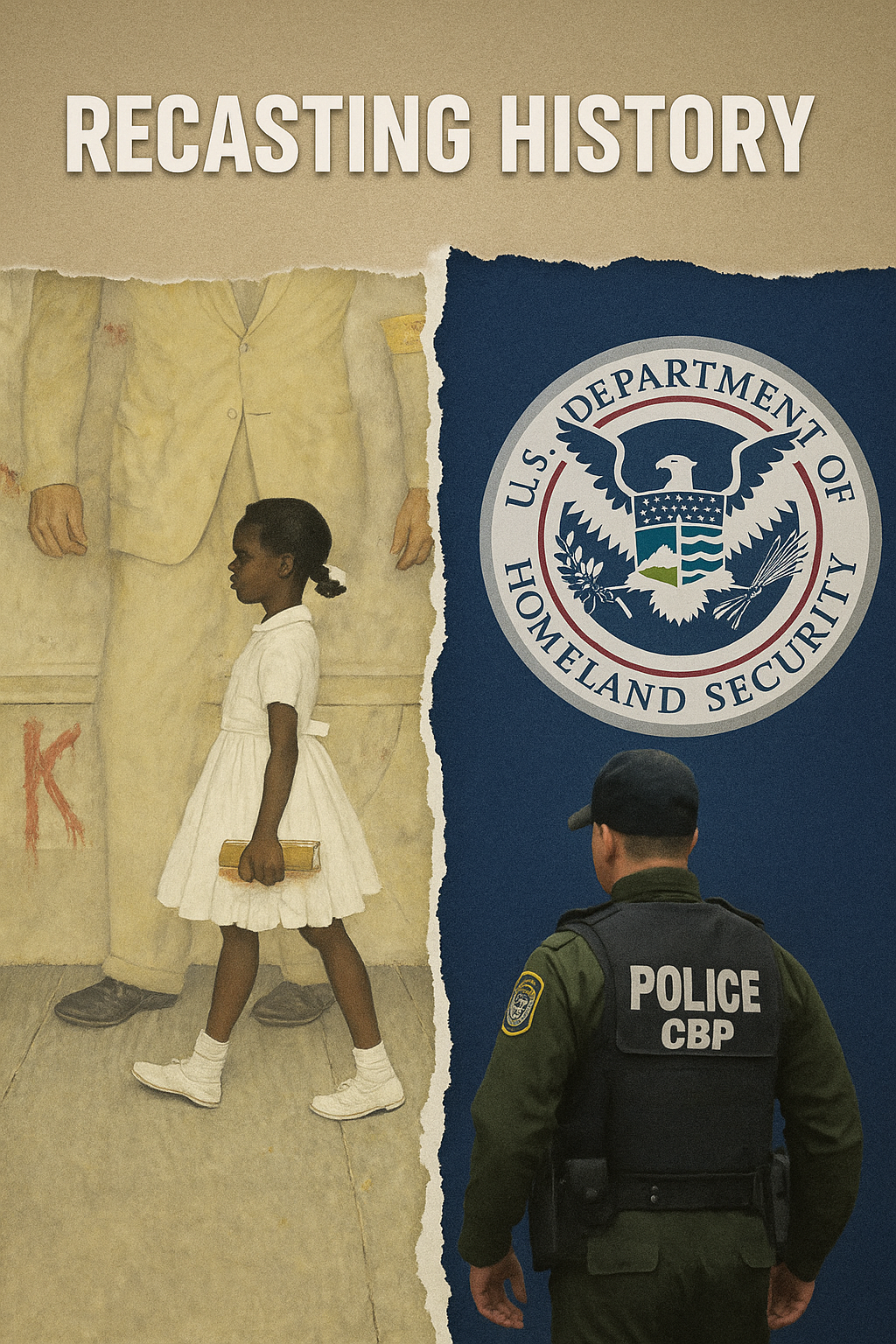
Worth a deep look: I just read a piece in USA Today about how the U.S. Department of Homeland Security has been using art by Norman Rockwell to promote an anti-immigrant message — and the Rockwell family is furious. X (formerly Twitter)+2Artnet News+2
🎨 What struck me: this is a clear example of how history, imagery, and culture can be recast to fit a narrative — rather than the other way around.
🧭 Here are a few thoughts:
- Rockwell’s art is often seen as nostalgic Americana — everyday scenes, wholesome values. His later work though explicitly confronted racism (for example “The Problem We All Live With” in 1964) and acknowledged his own biases. Rehs Galleries+1
- The use of his earlier style — stripped of its later context — by a federal agency to send a message about “protecting the homeland” and immigration is a reframing. It’s saying: this is what America is and this is who is in / who is out.
- When we allow or participate in these kinds of recastings, we risk losing sight of actual history — the full complexity, the contradictions, the voices left out.
- This matters because culture, memory and art aren’t simply decorations — they’re part of how we define ourselves, our national story, our identity. When a piece of art is used in a way that contradicts its origin or its meaning, we should ask: Who is benefiting from this reinterpretation? Who is erased?
- And this isn’t just about art. Across the country, we’re seeing efforts to erase or sanitize parts of our history — removing what makes us uncomfortable, editing out what doesn’t fit the narrative we prefer. But history’s purpose isn’t to protect our comfort. It’s to shape our conscience.
🔍 So my takeaway: History and art are powerful. They can be anchors, reminders of where we’ve been—and also warnings of how we might be asked to see ourselves. If we let others define the narrative unchallenged, especially when it’s recast to exclude or marginalize, we lose more than a painting’s original intent — we risk losing integrity in our shared story.
👉 Link to read: USA Today article
Let’s stay vigilant — not just about what gets presented, but how it’s being presented. And let’s keep the conversation alive about who gets to define “us.”
 Phillip Wright