Thoughts and Prayers?

Featured

Here we go again.  

Another mass shooting.  

Another round of “thoughts and prayers.”  

I’m not denigrating thoughts and prayers – I want to be more thoughtful and prayerful.

But…

We’ve been “thinking and praying” since Columbine and the problem seems worse than ever.  

Just look at the ever-increasing numbers of mass shootings in the U.S:

  • 2019: 417
  • 2021: 693
  • In 2022?  There have been more mass shootings than there have been days in the new year – over 200.  

“Thoughts and prayers” don’t seem to be working.  I wonder if God is telling us what he told the people of Judah through Isaiah: 

I cannot bear your worthless assemblies…

When you spread out your hands in prayer

I hide my eyes from you

Even when you offer many prayers

I am not listening. 

Why is God not listening to the prayers? Glad you asked:  

Your hands are full of blood!

Take your evil deeds out of my sight; 

Stop doing wrong

Learn to do right; seek justice.

Defend the oppressed…  (Isaiah 1:11-18)

That’s like God is saying that to the U.S. today – “Hands full of blood”!

The emptiness of thoughts and prayers spread to the northern kingdom of Israel too. Speaking on God’s behalf, Amos writes: 

I get no pleasure from your religious assemblies…

Take away from me your noisy songs…

Justice must flow like torrents of water,

Righteous actions like a stream than never dries up (Amos 5:21-24)

Have the emptiness of “thoughts and prayers” spread to the United States?  I think so.  

Maybe we need to respond with “thoughts and prayers and…action.” What a novel idea!  Father Rohr gets it.  He named his organization “The Center for Action and Contemplation.”

*Contemplation helps us see the world through the eyes of God – seeing God and reflecting God.

*Action is…well, ACTION.  It’s getting off our butts, or knees, and doing something.

Father Rohr says the most important word in the name is neither “Action” or “Contemplation” but, “and”.

It takes both. 
Let’s do both. 

“Faith, by itself, if it is not accompanied by action, is dead.”  James 2:17   

Maybe there wouldn’t be so many deaths if our faith was not dead.  

One Religion

Featured

“So, if we are going to have one nation under God, which we must, we have to have one religion, one, one, one nation under God and one religion under God.  Right? All of us together. Working together.”  

These are the words of Michael Flynn spoken in an address at the ReAwaken America tour which stopped at John Hagee’s church in San Antonio, Texas the weekend of November 14-15.  

“One religion” is not a surprising concept to me.  Michael Flynn is not the first person I’ve heard give voice to that view.  I heard it in the 70s and 80s from the Moral Majority and preachers who were sucked into that movement – I was one of them.  

I heard it from myself.  

I don’t talk that way anymore.  I don’t think that way anymore. 

Why? 

History.  The Constitution.  My evolving understanding of Jesus.  The Handmaid’s Tale (The US is not Gilead).

What religion is Flynn proposing the US should officially adopt or enforce?  I think we know the answer.   

Now, imagine if a Muslim or Jewish American leader made the same comment that the United States should have one faith, and that it should be Islam or Judaism.  The outrage from the religious right would be deafening.  But, strangely, I haven’t heard a peep of criticism from the religious right for these comments.  

Here’s where I am today.  

The Dalai Lama describes his religion in this way:  “My religion is kindness.”  

Ok, if that were the religion referred to by Flynn, that might be ok.  One religion of kindness.  All of us together.  Working together toward  kindness.  

That’s golden.  In fact, it’s the golden rule we’ve all learned: “Do unto others as you would have them do unto you.”  

Yeah, we must have that religion.  

COVID-19 and Palm Sunday

Featured

Thank You

Happy Palm Sunday

Jesus arrives in Jerusalem, riding on a donkey.

Pilate has also arrived, riding on a war horse.  

Two leaders. Two different ways of leading. 

Two animals. Two different images.

When writing about this event, Matthew reflects on Zechariah 9:9:

“Say to Daughter Zion (Jerusalem), 

‘See, your king comes to you,

Gentle and riding on a donkey,

Even upon a colt, a foal of a beast of burden.

“Gentle?”  

“Riding on a donkey, even a foal of a beast of burden”?  (No, the Rolling Stones are not the originators of the phrase.)

What kind of King is this? 

Where’s the display of power? 
Where’s the “Hey, I’m a big deal!” attitude? 

It’s not there.  We won’t “see” that in Jesus. In Jesus, we “see” a different way to live and to lead.  Jesus is reframing power. Oh, yes, Jesus has power.  “All power (authority) has been given to me (Matthew 28:18),” Jesus tells his disciples.

But this Jesus kind of power is “seen” not in the person who is served but in the person who is serving (Matthew 20:25-28).  

Wanna see power today?  Look at  the 1000s of medical personnel serving us, “giving their lives as a sacrifice” in this war against COVID-19.  

That is power on display.  

On this Palm Sunday, the beginning of Passion Week, we thank them for their passionate and sacrificial service.


Stand Your Butt Up!

Bro-masculinity is running the country. Jesus had a different idea.

Last night I sat in a circle with potential Connection Group leaders. We passed a talking piece. We listened. No interrupting. No fixing. Just presence. At one point I asked: If you could guide a group to explore anything, what would it be? One man said he wanted to understand what it actually means to be a man, in a culture soaked in what gets called toxic masculinity.

I do too.

While we’re asking that question in circles, an answer is being modeled in the halls of power. It goes something like this: a man is tough, combative, dominance-oriented, physically intimidating, and allergic to nuance. He does not apologize. He does not feel things, or if he does, he expresses them through aggression. It’s not okay to cry, but it’s okay to punch a hole in the wall.

Ladies and gentlemen, meet your government.

The Department of War (He really wanted that name)

Secretary Hegspeth has been clear about his approach to wars in general and in the Iran War in particular:  no “politically correct wars,” no restraint, no nuance. “No quarter, no mercy.” Which sounds less like a Pentagon briefing and more like a line cut from a Braveheart sequel. Legal experts note that “no quarter” has a precise meaning in international law — it means take no prisoners, and that threatening it may itself constitute a war crime. The Pentagon’s own Law of War Manual prohibits it. Does Hegseth see that manual as part of the problem.

And then came the videos.

Actual military strikes on Iran, edited together with clips from Call of Duty, Top Gun, Braveheart, and Grand Theft Auto. A real explosion labeled “WASTED” — the term GTA uses for a kill. The montage ended with audio from Mortal Kombat: “Flawless victory.” The caption: “JUSTICE THE AMERICAN WAY.”

This was posted less than a week after an airstrike killed more than 170 people at an Iranian girls’ school, mostly children, and one day after the Pentagon named American soldiers killed in the same conflict. Ben Stiller demanded the White House remove a clip from his film Tropic Thunder — a satire about the absurdity of war movies, writing simply: “War is not a movie.”

I get strong leadership. But when real lives are edited like entertainment, when death gets a GTA sound effect, we should pause long enough to ask: Is this strength? Or is this performance? Because there is a difference between being decisive and needing everything to feel like a win on a screen.

The Senate as Fight Club

Then there is Markwayne Mullin — Senator from Oklahoma, former MMA fighter, and now Trump’s nominee to lead the Department of Homeland Security. In 2023, during a Senate hearing, Mullin challenged Teamsters president Sean O’Brien to a fight. Mid-hearing. He stood up, removed his wedding ring, and said: “You want to run your mouth? We can be two consenting adults. We can finish it here.” Senator Bernie Sanders, serving as committee chair and the only adult apparently in the room, interrupted: “No. No. Sit down. You are a United States Senator.”

This week at his confirmation hearing, Rand Paul confronted Mullin — not on policy, but on character. He asked, essentially: Can you show restraint? Reflection? Accountability? Mullin’s answer was unambiguous: “I’m not apologizing. If I have something to say, I’ll say it to your face. I won’t back down from a challenge.”

That exchange names the question underneath all of this. Is strength the ability to hold your ground, or the wisdom to know when to soften it? Because those are two very different kinds of power.

What Jesus Actually Looked Like

Here’s what troubles me, not just as a citizen, but as someone trying to follow Christ.

This version of masculinity has made deep inroads in American Christianity. There is an entire industry of books, conferences, and ministries built on the idea that the church has produced too many soft men,  that Jesus needs to be recovered as a warrior-king, and that what men really need is permission to be aggressive, dominant, and unapologetically hard.

What gets lost in that reclamation project is almost everything about the actual Jesus of the Gospels.

The one who wept at a tomb. Who stopped to notice a woman who had been bleeding for twelve years, when everyone else had walked past her for a decade. Who said the meek, not the aggressive, the meek, would inherit the earth. Who, when Peter drew a sword in the garden and took off a man’s ear, didn’t say “nice swing.” He said put it away, and then healed the ear.

That Jesus was not soft. He overturned tables, confronted religious leaders to their faces, and walked toward Jerusalem knowing exactly what waited for him. But his power never needed to prove itself. It never postured. It never performed.

He knelt down and washed feet. No flex. Just presence.

At its core, the bro-masculine model isn’t about strength, it’s about proving strength. And that distinction matters enormously. Because the louder the need to prove it, the more likely something underneath doesn’t feel secure. Real strength can say I don’t know. It can admit I was wrong. It can choose patience over posturing. It doesn’t need to win the room. It knows how to hold it.

Which sounds a lot less like the loudest voices in Washington, and a lot more like Jesus.

So What Does a Man Look Like?

This is the question the man in my group was asking. It deserves better than what Washington is currently modeling.

A man can be physically strong and emotionally available. Competitive and also kind. Able to hold a position under pressure and also change his mind when he’s wrong. Able to protect people without dominating them. Angry about injustice without turning every room into a cage match or every war into a content strategy.

What are watching right now? Is it strength. Or is it the elaborate performance of strength by men who are afraid that without the performance, no one will take them seriously?  The tattoos, the challenge tweets, the renamed departments, the Mortal Kombat soundtracks over real missile strikes — these are not the marks of security. They are the markings of men who have confused domination with dignity.

The good news, for those of us who follow a man who refused to come down from a cross to prove he could, is that there is another way.

It’s harder. It’s less photogenic. It doesn’t go viral.

But it’s actual strength. And in the long run, as Jesus had a habit of demonstrating, it wins.

— The Rev

________________________________

Phillip is the founding pastor of The Venues, a progressive faith community. He writes weekly at “Random Thoughts from the Rev.”

We’re Not Just Arguing About the Future — We’re Rewriting the Past

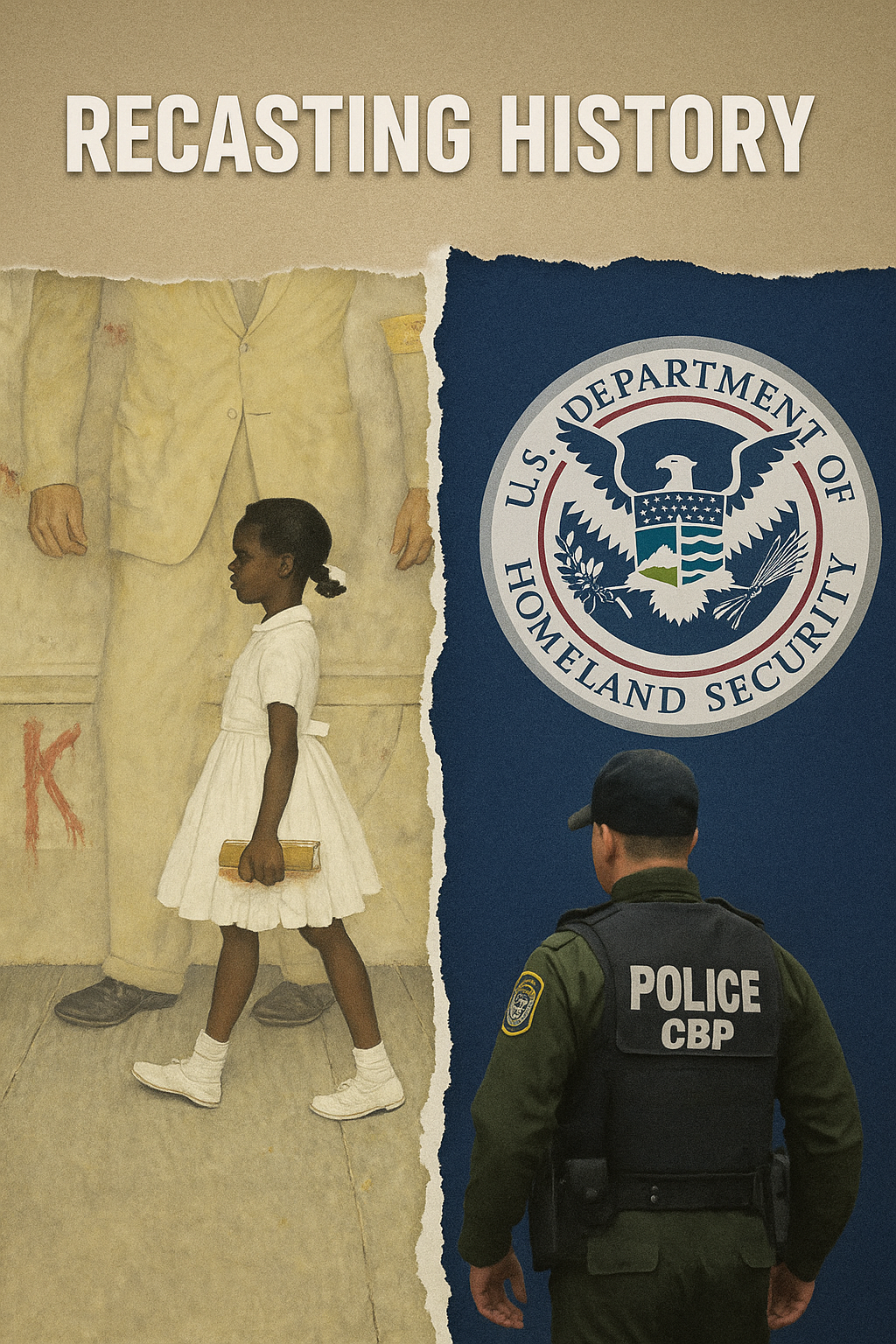
Worth a deep look: I just read a piece in USA Today about how the U.S. Department of Homeland Security has been using art by Norman Rockwell to promote an anti-immigrant message — and the Rockwell family is furious.  X (formerly Twitter)+2Artnet News+2

🎨 What struck me: this is a clear example of how history, imagery, and culture can be recast to fit a narrative — rather than the other way around.

🧭 Here are a few thoughts:

  • Rockwell’s art is often seen as nostalgic Americana — everyday scenes, wholesome values. His later work though explicitly confronted racism (for example “The Problem We All Live With” in 1964) and acknowledged his own biases. Rehs Galleries+1
  • The use of his earlier style — stripped of its later context — by a federal agency to send a message about “protecting the homeland” and immigration is a reframing. It’s saying: this is what America is and this is who is in / who is out.
  • When we allow or participate in these kinds of recastings, we risk losing sight of actual history — the full complexity, the contradictions, the voices left out.
  • This matters because culture, memory and art aren’t simply decorations — they’re part of how we define ourselves, our national story, our identity. When a piece of art is used in a way that contradicts its origin or its meaning, we should ask: Who is benefiting from this reinterpretation? Who is erased?
  • And this isn’t just about art. Across the country, we’re seeing efforts to erase or sanitize parts of our history — removing what makes us uncomfortable, editing out what doesn’t fit the narrative we prefer. But history’s purpose isn’t to protect our comfort. It’s to shape our conscience.

🔍 So my takeaway: History and art are powerful. They can be anchors, reminders of where we’ve been—and also warnings of how we might be asked to see ourselves. If we let others define the narrative unchallenged, especially when it’s recast to exclude or marginalize, we lose more than a painting’s original intent — we risk losing integrity in our shared story.

👉 Link to read: USA Today article

Let’s stay vigilant — not just about what gets presented, but how it’s being presented. And let’s keep the conversation alive about who gets to define “us.”

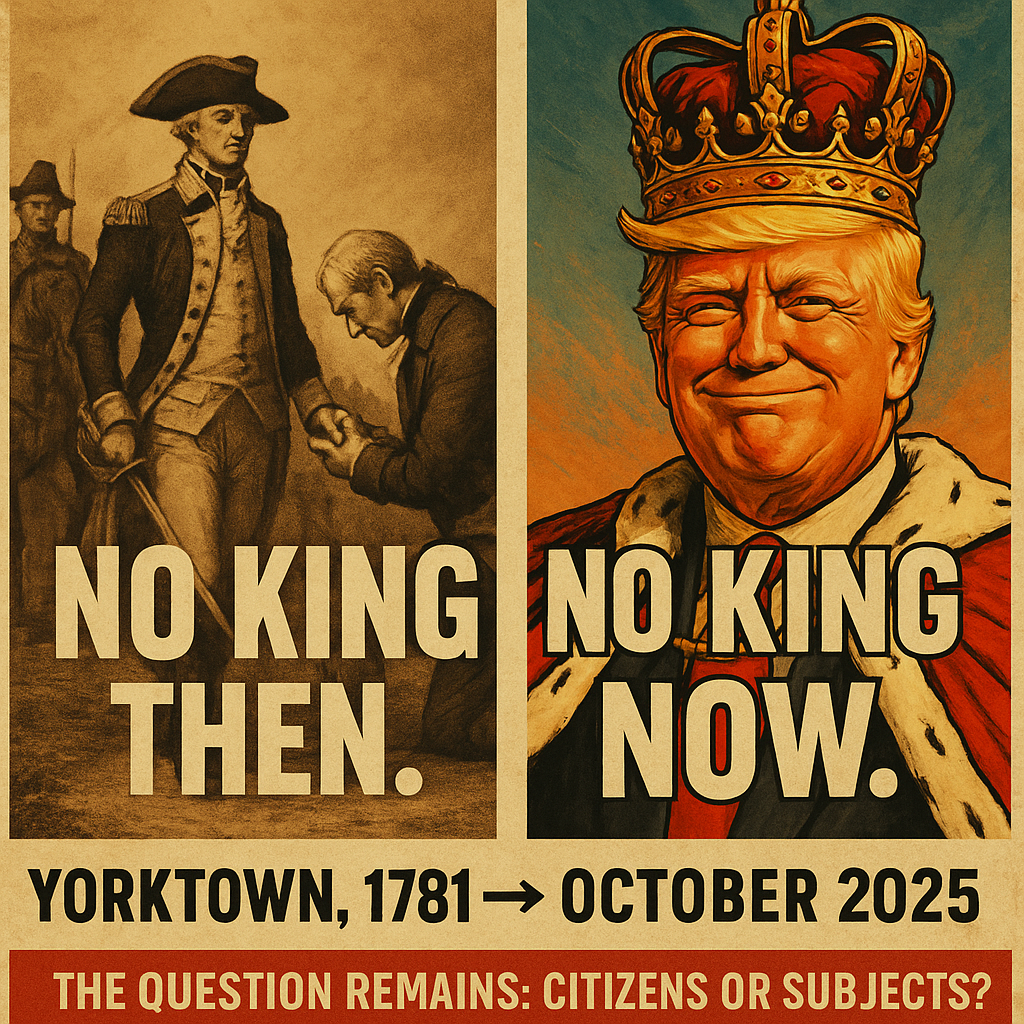
“The Republic and the Crown: A Reminder from October 19, 1781.”

Yorktown, 1781 — A Surrender Worth Remembering

Sunday, October 19, was the 244th anniversary of  the surrender of British General Lord Cornwallis to General George Washington at Yorktown. The cannons quieted, the flags lowered, and something even more revolutionary than independence took shape:
The rejection of kingship as a way of political life.

What followed — the Treaty of Paris in 1783 — didn’t just recognize a free nation. It recognized a new kind of people:
A people who refused the crown.

George Washington could have taken one. He didn’t. He handed power back and walked away. He set the standard:
In America, leaders serve. They do not reign.

October 18, 2025 — The “No Kings” Rallies

Yesterday, across the country, millions rallied under a simple phrase: No Kings.
Their message wasn’t partisan. It was historical.
It cut back to Yorktown.
It reached forward to now.

But almost immediately, a wave of pushback surfaced from certain voices:

“Trump isn’t a king. These rallies are overreacting.”
“Nobody is actually calling him a king.”

And yet — the same day — from the White House and the president’s own accounts came AI-generated images and videos celebrating exactly that idea:

  • Trump in a crown and royal robe, sword in hand, as a chorus sings “Hail to the King.”
  • Trump flying a fighter jet labeled “KING TRUMP,” dropping excrement on protesting citizens.
  • Opponents digitally altered to bow before him.
  • An official image of Trump and JD Vance wearing crowns, contrasted with political opponents mocked in sombreros.

It’s not the first time the White House has posted an image of Trump as King.

So when citizens respond by chanting No Kings, and some leaders respond with, Relax, he’s not a king — while sharing imagery literally celebrating kingship — we are not just debating politics.

We are debating memory. Identity. The meaning of Yorktown.

A Moment of National Self-Reflection

This is not about whether one supports Trump or opposes him. This is deeper.
This is about whether we still agree to the founding claim: No crowns on this soil.

The Call of the Moment

We are living in a time where symbolism matters — and symbols of royalty are being reintroduced into our public imagination.
Not quietly. Not accidentally. But proudly.

So maybe the question isn’t whether Trump wants to be king.

Maybe the question is:

Do we still want to be the kind of people who say no to kings — not just in 1781, but now?

Yorktown wasn’t just a battle site.
It was a vow.
A vow worth repeating.

When the Southern Baptist Convention Decides to Ban Same-Sex Marriage: A Personal Reflection

The SBC voted yesterday to not just oppose same-sex marriage (that’s old news), but to work toward banning it. Because when you think “the hands and feet of Jesus,” you definitely think, How can we make sure two people in love can’t get married?

The resolution urges lawmakers to “pass laws that reflect the truth of creation and natural law — about marriage, sex, human life, and family” and to oppose laws that contradict “what God has made plain through nature and Scripture.”

Ah yes, my favorite phrase: “What God has made plain.”

I always get a little twitchy when people say that. Not because I don’t believe in truth — I do. Not because I don’t love Scripture — I do. It’s just that, historically, what’s been “plain” to religious gatekeepers has had an unfortunate tendency to shift over time.

Slavery? Once plain.
Segregation? Plain as day.
Keeping women out of leadership? Plain, still on sale in aisle 3.
And now, denying LGBTQ+ people the right to marry? Apparently, that’s plain too.
What’s “plain” to some often depends on where they’re standing, who they’re listening to, and what they’ve been taught to see.

When people say, “It’s plain in nature and Scripture,” it often functions less as an invitation to seek understanding and more as a way to end the conversation — to shut down curiosity, complexity, and most of all, dissent.

I grew up Southern Baptist. I led Southern Baptist churches. I was trained in Southern Baptist seminaries. I loved the people. I still do. I also loved the Bible I was taught to read and wrestle with — a Bible full of stories where God consistently surprises us, calls us to love bigger, and often works through the very people we were told to exclude.

Over time, I became affirming. Not because the culture pushed me, but because the Gospel pulled me. I listened to LGBTQ+ Christians. I studied Scripture with new eyes. I prayed. I questioned. I changed.

It wasn’t easy. It cost me relationships and eventually my place in a church I once called home.

But I’ve never regretted moving toward love.

What’s Actually Happening Here

Let’s be clear: the SBC working to ban same-sex marriage isn’t about protecting “natural law.” It’s about enforcing their particular version of it.

It’s one thing to hold a belief inside your church walls. That’s your right. It’s another thing to try to legislate it onto everyone else. That’s called theocracy, and last I checked, America wasn’t supposed to be one.

Religious freedom means you get to practice your faith — and so does your neighbor, even if their faith (or their marriage) looks different from yours. That’s the deal. That’s the country we say we love. Or at least, it’s supposed to be.

But apparently, some aren’t satisfied unless their particular brand of righteousness is the law of the land.

The Witness Left Behind

What grieves me most is that this kind of move — loud, forceful, certain — is exactly the kind of move that makes people walk away from faith altogether.

I know. I’ve sat with them.
I’ve heard their stories.
I’ve seen the ache in their eyes.

And here’s the hard truth: the SBC can pass all the resolutions it wants. It can work the legislative angles, it can vote, it can posture, it can campaign.

But you know what it can’t do?
It can’t stop love.

Love will outlast this.
Affirming churches will outlast this.
LGBTQ+ marriages will outlast this.
The Jesus who shatters dividing walls will outlast every committee that keeps trying to build them back up.

So when Clint Pressley, the second term President of the SBC, says, “It is good to be a Southern Baptist,” I can only offer a polite smile and a quiet, “Bless your heart.”

It’s good to be on the side of love.
It’s good to be with the people who’ve been told they don’t belong — because they always have.

Also? It’s really good to have brunch without looking over your shoulder.

When Religion is Used to Discriminate

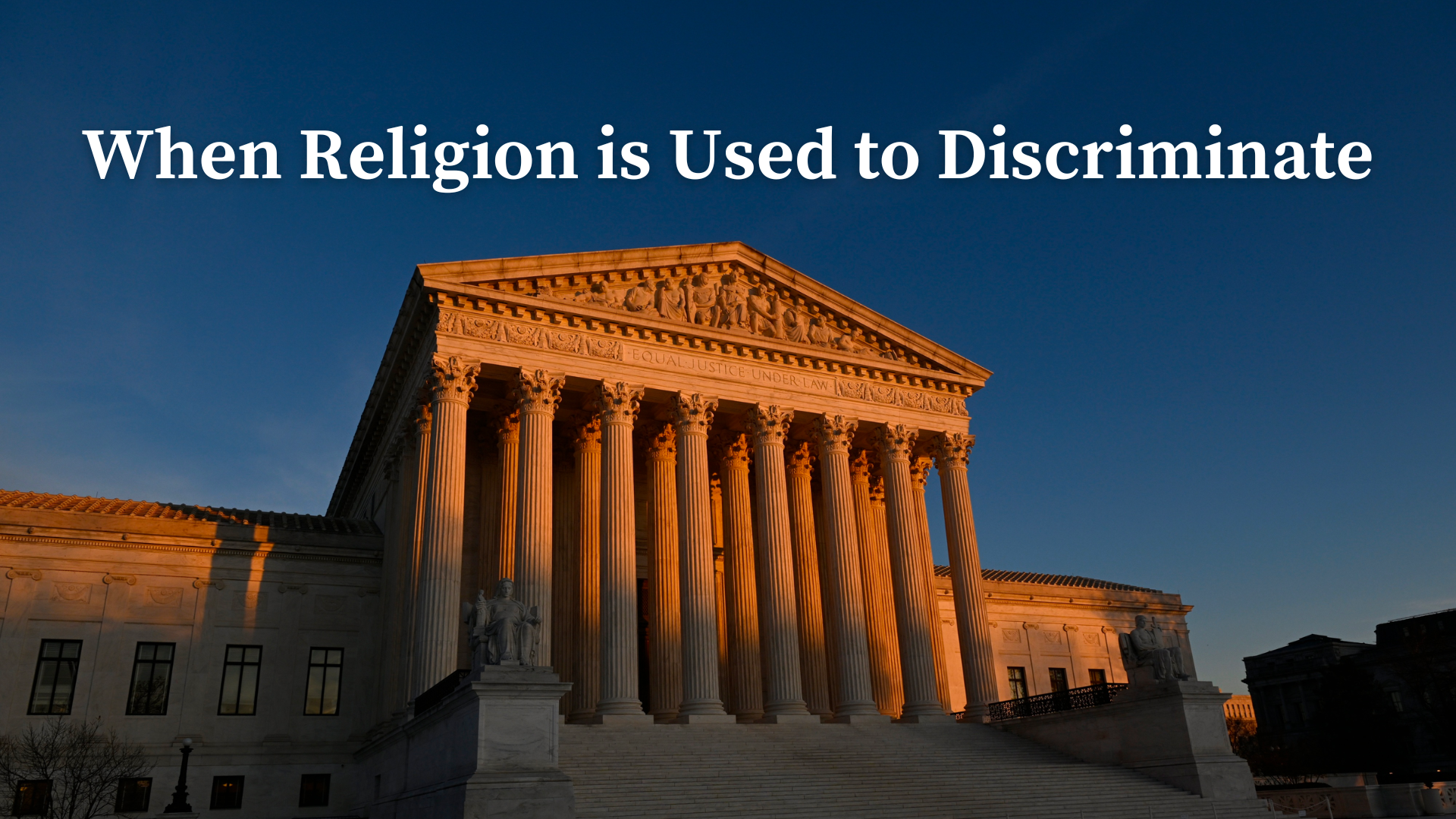
Pride Month came to a sad end with a ruling from the Supreme Court allowing businesses to refuse services to LGBTQ+ individuals based on religious objections.  

We’ve seen this before – religion being used as an excuse to discriminate.   

In 1968 the Supreme Court heard a case from South Carolina in which a white supremacist, Maurice Bessinger, who ran a chain of Piggie Park Bar-B-Q restaurants, refused service to a black man, John W. Mungin, because he believed the races should be strictly segregated. Mungin claimed the action was in violation of the recently passed Civil Rights Act (1964).  The store owner invoked a higher law – God’s – or, should I say, “His view of God’s law.”?  

Here’s what Bessinger’s lawyers wrote in answer to Mungin’s complaint: 

 “Bessinger believes as a matter of faith that racial intermixing or any contribution thereto contravenes the will of God.” 

Does anyone really think now that Bessinger was right then – that following God allows us, even compels us, to discriminate against other races? 

Yes, sadly, some do.  

Gladly, most don’t. 


1968 was 55 years ago.  The Justices in that case, unanimous in their ruling against Piggie Park, called the religious freedom defense for the race-based denial of service, “patently frivolous,” and ordered Bessinger to pay Mungin’s attorneys’ fees. 

We obviously have a different SCOTUS today. 

But we have the same prejudices – just toward another group.  

In 2078, 55 years from now, will Americans look back on today’s court decision, on today’s anti-LGBTQ+ attitudes and wonder, “How could we have thought that?”

We got the Bible wrong in 1968.

We got God wrong in 1968.   

Maybe we are getting them wrong today.   

Fr Richard Rohr explains that the core and call of religion (re-ligio) is to “re-ligament” us.  Instead of using religion to divide and discriminate, let’s use it in these “United” States to actually unite, providing “liberty and justice for all.”  

When Nature Calls…

…at an awkward time…

Do you answer? 

Do you put the call on hold? 

But what if nature won’t be placed on hold?

What do you do?  

Nature gave me a call last Sunday during the Sunday morning service a few minutes before it was time for me to step up on the platform and deliver the weekly sermon.  

I tried to ignore the call knowing it would call back later.   But Nature would not wait.  

Didn’t Nature know what time it was and where I was?!

Ecclesiastes 3:1 says there is a time for everything.  Really?  Is this the right time?  

“I think I can make it back,” I whispered to Denise, my wife, sitting beside me, and tried to walk nonchalantly from the front row to the hallway restroom. 

I should have run. I didn’t make it back in time.  I stepped out of the restroom and didn’t hear the video or the special song that was set to play before I taught.  Uh oh.  

Opening the auditorium doors, I saw Dense on the platform trying to cover for me.  

I should have let her have the stage! 

I felt like Doja Cat.   ​​When Doja Cat and SZA won the Grammy in 2022 for Best Pop Duo Performance for “Kiss Me More,” Doja nearly missed it. The star was in the middle of a bathroom visit when her name was called and she barely made it to the stage before it was time to get to the next category. 

When nature calls you, you listen, even if it means missing your very first Grammy win or a sermon.  

The folks that gathered at The Venues Church Sunday totally understood.  

The Venues is a safe place to be human.  To be you.   

It was good for a laugh.  

The lesson?  Maybe when Nature, when God, when Love calls, we listen. 

When creation speaks, we listen. When others speak, we listen.  

Listening.  Father Rohr writes, “Perhaps one of the most precious and powerful gifts we can give another person is to really listen to them, to listen with quiet, fascinated attention, with our whole being, fully present.”

Listen with an open heart.  No judgment.  Just openness.  

Thank-you Venues community for listening and not judging.

Let’s Not Stop With a Quote

We heard a lot of Martin Luther King, Jr quotes in sermons on Sunday and in speeches on Monday.  There is a reason that Dr. King may just be the most quoted person on the planet.  His words lift us up, challenge us, calling us to be our better selves.

Sit back and read these words.  Let them soak into your spirit.  

  • “Darkness cannot drive out darkness: Only light can do that.  Hate cannot drive out hate:  Only love can do that.”
  • “Let no man pull you so low as to hate him.”
  • “We must learn to live together as brothers or perish together as fools.” 
  • “All we say to America is, ‘Be true to what you said on paper.’ …”
  • “Rarely do we find men who willingly engage in hard, solid thinking. There is an almost universal quest for easy answers and half-baked solutions. Nothing pains some people more than having to think…The greater the lie, the more readily will it be believed.”
  • “I have the audacity to believe that people everywhere can have three meals a day for their bodies, education and culture for their minds, and dignity, equality, and freedom for their spirits.”  
  • “If we are to have peace on earth, our loyalties must become ecumenical rather than sectional. Our loyalties must transcend our race, our tribe, our class, and our nation; and this means we must develop a world perspective.”
  • “Everyone has the power for greatness, not for fame but greatness, because greatness is determined by service.” 
  • “Philanthropy is commendable, but it must not cause the philanthropist to overlook the circumstances of economic injustice which make philanthropy necessary.”

Today is Tuesday.  MLK Day is behind us.  

What will we do with these quotes?  Save them til MLK Day 2024?   

How about this:  Put the quotes into practice?

Living in the Now While Waiting for the Biopsy

I found another spot.  On my way to conduct a funeral Friday afternoon, I glanced in the rearview mirror while at a stop light to make sure I didn’t have anything unsightly on my face, nose, mouth before arriving at the funeral home.

That’s when I saw the spot.  A white mark on my upper lip.  It wouldn’t wipe off. “Rats,” I said to no one in particular.  I’ve seen that kind of mark before – on my arm.  

15 years ago. 

Melanoma.  

The light turned green so I drove on.  At the next red light I took a selfie and sent it to my friend and Dermatologist PA and asked, “What do you think?”  She replied within 5 minutes.  “Come in Monday.”

I went in.  I came out with a biopsied, bandaged upper lip.  

I’ve had two previous melanomas and one squamous cell carcinoma (the wound from that surgery is still healing).  

Now, I wait.  What will the biopsy show this spot to be?

I know the principles of living in the now.  But I don’t know how to live those principles all of the time. Sometimes I do it. Sometimes I don’t.  Right now, for me to live in the now, is a choice. 

It has yet to become an automatic response. 

The “right now” is this:

  • I don’t know the nature of the spot. That’s the fact.  So why worry about something that may not be?  Why let a fear of tomorrow rob me of the fun I can have today?
  • I feel good. At least until the anesthesia wears off!  
  • I have great care from the dermatology team.
  • I have this moment.  Right now.  That’s all I’m guaranteed. So, I will make this present moment, standing here typing and drinking from a straw, looking at Denise across the room, the best moment ever. 

I will live by Calvin’s philosophy when he says to Hobbs, “We’re so busy watching out for what’s just ahead of us that we don’t take time to enjoy where we are.” 


Men Behaving ….

After watching the video of Will Smith smacking Chris Rock after the comedian told a joke about Jada Pinkett Smith, how would you complete the line: Men Behaving _________?

Some commend Will Smith for “protecting his wife,” calling what he did, “beautiful,” “manly.”

Some criticize Will Smith for “toxic masculinity.”

Some commend Chris Rock for showing restraint and maturity for not smacking back and for not pressing charges (at least not yet).  

Some criticize Chris Rock for bad taste in joking about someone’s health.  

What do you think?  What adverb would you use to complete the sentence? 

I think I’ll go with the title of the British sitcom – “Men Behaving Badly.”

And I think it applies to both men. 

I’m not saying they are bad men – just that their behavior was bad.  

Maybe both men need to take a step back for a little re-evaluation. 

Chris Rock:  I’ve always cringed at jokes that target health issues of people.  I just don’t see Jesus doing that.  Or maybe it was because I received my share of “teasing” as a kid for my speech impediment.  

Will Smith: Well, what he did was assault.  I wonder if we have fallen asleep to basic standards of human decency and civility.  Our leaders have been openly cruel and mean and in so doing have given us permission to be and do the same.  This is where we are. 

In his speech after receiving the Oscar for actor for his role in “King Richard” (Loved that movie!), Will said, “I’m being called on in my life, to love people and to protect people.” And then he said this: “Love will make you do crazy things.”  

Will Smith, Nope.  Just ask a victim of abuse whose abuser uses that same line.  

We all can do better.  And hopefully, when we know better, we will do better (Thank you, Maya Angelou).