We’re Not Just Arguing About the Future — We’re Rewriting the Past

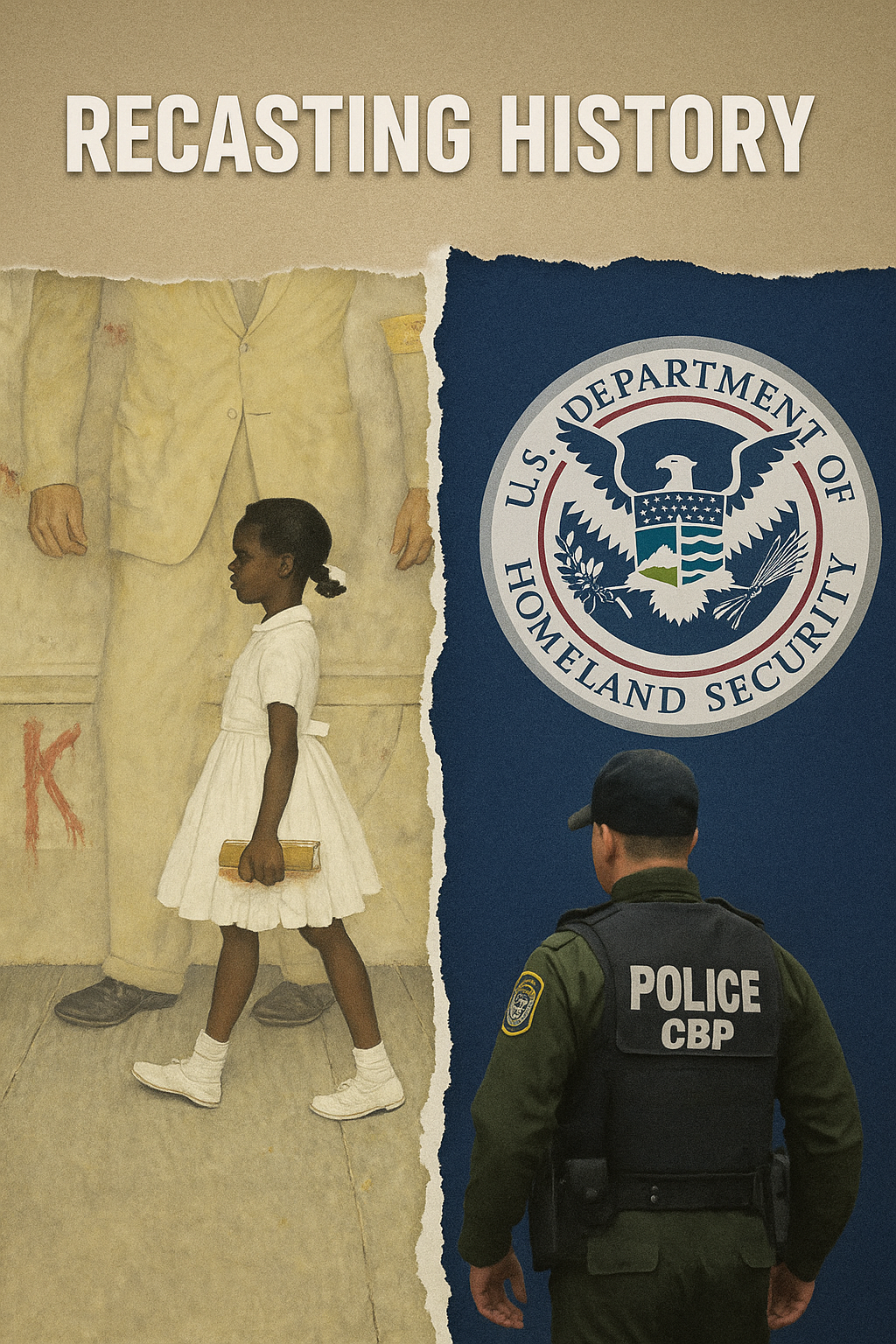
Worth a deep look: I just read a piece in USA Today about how the U.S. Department of Homeland Security has been using art by Norman Rockwell to promote an anti-immigrant message — and the Rockwell family is furious.  X (formerly Twitter)+2Artnet News+2

🎨 What struck me: this is a clear example of how history, imagery, and culture can be recast to fit a narrative — rather than the other way around.

🧭 Here are a few thoughts:

  • Rockwell’s art is often seen as nostalgic Americana — everyday scenes, wholesome values. His later work though explicitly confronted racism (for example “The Problem We All Live With” in 1964) and acknowledged his own biases. Rehs Galleries+1
  • The use of his earlier style — stripped of its later context — by a federal agency to send a message about “protecting the homeland” and immigration is a reframing. It’s saying: this is what America is and this is who is in / who is out.
  • When we allow or participate in these kinds of recastings, we risk losing sight of actual history — the full complexity, the contradictions, the voices left out.
  • This matters because culture, memory and art aren’t simply decorations — they’re part of how we define ourselves, our national story, our identity. When a piece of art is used in a way that contradicts its origin or its meaning, we should ask: Who is benefiting from this reinterpretation? Who is erased?
  • And this isn’t just about art. Across the country, we’re seeing efforts to erase or sanitize parts of our history — removing what makes us uncomfortable, editing out what doesn’t fit the narrative we prefer. But history’s purpose isn’t to protect our comfort. It’s to shape our conscience.

🔍 So my takeaway: History and art are powerful. They can be anchors, reminders of where we’ve been—and also warnings of how we might be asked to see ourselves. If we let others define the narrative unchallenged, especially when it’s recast to exclude or marginalize, we lose more than a painting’s original intent — we risk losing integrity in our shared story.

👉 Link to read: USA Today article

Let’s stay vigilant — not just about what gets presented, but how it’s being presented. And let’s keep the conversation alive about who gets to define “us.”

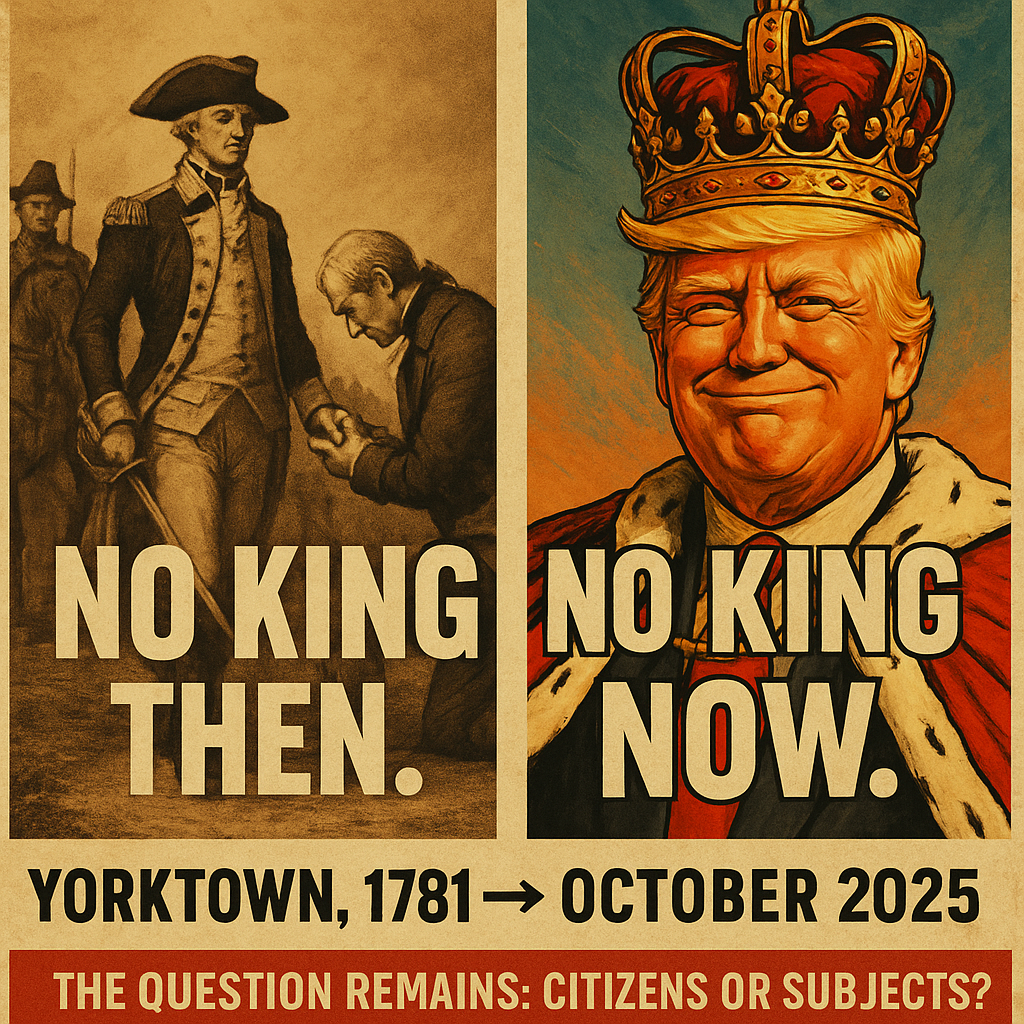
“The Republic and the Crown: A Reminder from October 19, 1781.”

Yorktown, 1781 — A Surrender Worth Remembering

Sunday, October 19, was the 244th anniversary of  the surrender of British General Lord Cornwallis to General George Washington at Yorktown. The cannons quieted, the flags lowered, and something even more revolutionary than independence took shape:
The rejection of kingship as a way of political life.

What followed — the Treaty of Paris in 1783 — didn’t just recognize a free nation. It recognized a new kind of people:
A people who refused the crown.

George Washington could have taken one. He didn’t. He handed power back and walked away. He set the standard:
In America, leaders serve. They do not reign.

October 18, 2025 — The “No Kings” Rallies

Yesterday, across the country, millions rallied under a simple phrase: No Kings.
Their message wasn’t partisan. It was historical.
It cut back to Yorktown.
It reached forward to now.

But almost immediately, a wave of pushback surfaced from certain voices:

“Trump isn’t a king. These rallies are overreacting.”
“Nobody is actually calling him a king.”

And yet — the same day — from the White House and the president’s own accounts came AI-generated images and videos celebrating exactly that idea:

  • Trump in a crown and royal robe, sword in hand, as a chorus sings “Hail to the King.”
  • Trump flying a fighter jet labeled “KING TRUMP,” dropping excrement on protesting citizens.
  • Opponents digitally altered to bow before him.
  • An official image of Trump and JD Vance wearing crowns, contrasted with political opponents mocked in sombreros.

It’s not the first time the White House has posted an image of Trump as King.

So when citizens respond by chanting No Kings, and some leaders respond with, Relax, he’s not a king — while sharing imagery literally celebrating kingship — we are not just debating politics.

We are debating memory. Identity. The meaning of Yorktown.

A Moment of National Self-Reflection

This is not about whether one supports Trump or opposes him. This is deeper.
This is about whether we still agree to the founding claim: No crowns on this soil.

The Call of the Moment

We are living in a time where symbolism matters — and symbols of royalty are being reintroduced into our public imagination.
Not quietly. Not accidentally. But proudly.

So maybe the question isn’t whether Trump wants to be king.

Maybe the question is:

Do we still want to be the kind of people who say no to kings — not just in 1781, but now?

Yorktown wasn’t just a battle site.
It was a vow.
A vow worth repeating.

When the Southern Baptist Convention Decides to Ban Same-Sex Marriage: A Personal Reflection

The SBC voted yesterday to not just oppose same-sex marriage (that’s old news), but to work toward banning it. Because when you think “the hands and feet of Jesus,” you definitely think, How can we make sure two people in love can’t get married?

The resolution urges lawmakers to “pass laws that reflect the truth of creation and natural law — about marriage, sex, human life, and family” and to oppose laws that contradict “what God has made plain through nature and Scripture.”

Ah yes, my favorite phrase: “What God has made plain.”

I always get a little twitchy when people say that. Not because I don’t believe in truth — I do. Not because I don’t love Scripture — I do. It’s just that, historically, what’s been “plain” to religious gatekeepers has had an unfortunate tendency to shift over time.

Slavery? Once plain.
Segregation? Plain as day.
Keeping women out of leadership? Plain, still on sale in aisle 3.
And now, denying LGBTQ+ people the right to marry? Apparently, that’s plain too.
What’s “plain” to some often depends on where they’re standing, who they’re listening to, and what they’ve been taught to see.

When people say, “It’s plain in nature and Scripture,” it often functions less as an invitation to seek understanding and more as a way to end the conversation — to shut down curiosity, complexity, and most of all, dissent.

I grew up Southern Baptist. I led Southern Baptist churches. I was trained in Southern Baptist seminaries. I loved the people. I still do. I also loved the Bible I was taught to read and wrestle with — a Bible full of stories where God consistently surprises us, calls us to love bigger, and often works through the very people we were told to exclude.

Over time, I became affirming. Not because the culture pushed me, but because the Gospel pulled me. I listened to LGBTQ+ Christians. I studied Scripture with new eyes. I prayed. I questioned. I changed.

It wasn’t easy. It cost me relationships and eventually my place in a church I once called home.

But I’ve never regretted moving toward love.

What’s Actually Happening Here

Let’s be clear: the SBC working to ban same-sex marriage isn’t about protecting “natural law.” It’s about enforcing their particular version of it.

It’s one thing to hold a belief inside your church walls. That’s your right. It’s another thing to try to legislate it onto everyone else. That’s called theocracy, and last I checked, America wasn’t supposed to be one.

Religious freedom means you get to practice your faith — and so does your neighbor, even if their faith (or their marriage) looks different from yours. That’s the deal. That’s the country we say we love. Or at least, it’s supposed to be.

But apparently, some aren’t satisfied unless their particular brand of righteousness is the law of the land.

The Witness Left Behind

What grieves me most is that this kind of move — loud, forceful, certain — is exactly the kind of move that makes people walk away from faith altogether.

I know. I’ve sat with them.
I’ve heard their stories.
I’ve seen the ache in their eyes.

And here’s the hard truth: the SBC can pass all the resolutions it wants. It can work the legislative angles, it can vote, it can posture, it can campaign.

But you know what it can’t do?
It can’t stop love.

Love will outlast this.
Affirming churches will outlast this.
LGBTQ+ marriages will outlast this.
The Jesus who shatters dividing walls will outlast every committee that keeps trying to build them back up.

So when Clint Pressley, the second term President of the SBC, says, “It is good to be a Southern Baptist,” I can only offer a polite smile and a quiet, “Bless your heart.”

It’s good to be on the side of love.
It’s good to be with the people who’ve been told they don’t belong — because they always have.

Also? It’s really good to have brunch without looking over your shoulder.

When Religion is Used to Discriminate

Pride Month came to a sad end with a ruling from the Supreme Court allowing businesses to refuse services to LGBTQ+ individuals based on religious objections.  

We’ve seen this before – religion being used as an excuse to discriminate.   

In 1968 the Supreme Court heard a case from South Carolina in which a white supremacist, Maurice Bessinger, who ran a chain of Piggie Park Bar-B-Q restaurants, refused service to a black man, John W. Mungin, because he believed the races should be strictly segregated. Mungin claimed the action was in violation of the recently passed Civil Rights Act (1964).  The store owner invoked a higher law – God’s – or, should I say, “His view of God’s law.”?  

Here’s what Bessinger’s lawyers wrote in answer to Mungin’s complaint: 

 “Bessinger believes as a matter of faith that racial intermixing or any contribution thereto contravenes the will of God.” 

Does anyone really think now that Bessinger was right then – that following God allows us, even compels us, to discriminate against other races? 

Yes, sadly, some do.  

Gladly, most don’t. 


1968 was 55 years ago.  The Justices in that case, unanimous in their ruling against Piggie Park, called the religious freedom defense for the race-based denial of service, “patently frivolous,” and ordered Bessinger to pay Mungin’s attorneys’ fees. 

We obviously have a different SCOTUS today. 

But we have the same prejudices – just toward another group.  

In 2078, 55 years from now, will Americans look back on today’s court decision, on today’s anti-LGBTQ+ attitudes and wonder, “How could we have thought that?”

We got the Bible wrong in 1968.

We got God wrong in 1968.   

Maybe we are getting them wrong today.   

Fr Richard Rohr explains that the core and call of religion (re-ligio) is to “re-ligament” us.  Instead of using religion to divide and discriminate, let’s use it in these “United” States to actually unite, providing “liberty and justice for all.”  

Let’s Not Stop With a Quote

We heard a lot of Martin Luther King, Jr quotes in sermons on Sunday and in speeches on Monday.  There is a reason that Dr. King may just be the most quoted person on the planet.  His words lift us up, challenge us, calling us to be our better selves.

Sit back and read these words.  Let them soak into your spirit.  

  • “Darkness cannot drive out darkness: Only light can do that.  Hate cannot drive out hate:  Only love can do that.”
  • “Let no man pull you so low as to hate him.”
  • “We must learn to live together as brothers or perish together as fools.” 
  • “All we say to America is, ‘Be true to what you said on paper.’ …”
  • “Rarely do we find men who willingly engage in hard, solid thinking. There is an almost universal quest for easy answers and half-baked solutions. Nothing pains some people more than having to think…The greater the lie, the more readily will it be believed.”
  • “I have the audacity to believe that people everywhere can have three meals a day for their bodies, education and culture for their minds, and dignity, equality, and freedom for their spirits.”  
  • “If we are to have peace on earth, our loyalties must become ecumenical rather than sectional. Our loyalties must transcend our race, our tribe, our class, and our nation; and this means we must develop a world perspective.”
  • “Everyone has the power for greatness, not for fame but greatness, because greatness is determined by service.” 
  • “Philanthropy is commendable, but it must not cause the philanthropist to overlook the circumstances of economic injustice which make philanthropy necessary.”

Today is Tuesday.  MLK Day is behind us.  

What will we do with these quotes?  Save them til MLK Day 2024?   

How about this:  Put the quotes into practice?

Thoughts and Prayers?

Featured

Here we go again.  

Another mass shooting.  

Another round of “thoughts and prayers.”  

I’m not denigrating thoughts and prayers – I want to be more thoughtful and prayerful.

But…

We’ve been “thinking and praying” since Columbine and the problem seems worse than ever.  

Just look at the ever-increasing numbers of mass shootings in the U.S:

  • 2019: 417
  • 2021: 693
  • In 2022?  There have been more mass shootings than there have been days in the new year – over 200.  

“Thoughts and prayers” don’t seem to be working.  I wonder if God is telling us what he told the people of Judah through Isaiah: 

I cannot bear your worthless assemblies…

When you spread out your hands in prayer

I hide my eyes from you

Even when you offer many prayers

I am not listening. 

Why is God not listening to the prayers? Glad you asked:  

Your hands are full of blood!

Take your evil deeds out of my sight; 

Stop doing wrong

Learn to do right; seek justice.

Defend the oppressed…  (Isaiah 1:11-18)

That’s like God is saying that to the U.S. today – “Hands full of blood”!

The emptiness of thoughts and prayers spread to the northern kingdom of Israel too. Speaking on God’s behalf, Amos writes: 

I get no pleasure from your religious assemblies…

Take away from me your noisy songs…

Justice must flow like torrents of water,

Righteous actions like a stream than never dries up (Amos 5:21-24)

Have the emptiness of “thoughts and prayers” spread to the United States?  I think so.  

Maybe we need to respond with “thoughts and prayers and…action.” What a novel idea!  Father Rohr gets it.  He named his organization “The Center for Action and Contemplation.”

*Contemplation helps us see the world through the eyes of God – seeing God and reflecting God.

*Action is…well, ACTION.  It’s getting off our butts, or knees, and doing something.

Father Rohr says the most important word in the name is neither “Action” or “Contemplation” but, “and”.

It takes both. 
Let’s do both. 

“Faith, by itself, if it is not accompanied by action, is dead.”  James 2:17   

Maybe there wouldn’t be so many deaths if our faith was not dead.  

Men Behaving ….

After watching the video of Will Smith smacking Chris Rock after the comedian told a joke about Jada Pinkett Smith, how would you complete the line: Men Behaving _________?

Some commend Will Smith for “protecting his wife,” calling what he did, “beautiful,” “manly.”

Some criticize Will Smith for “toxic masculinity.”

Some commend Chris Rock for showing restraint and maturity for not smacking back and for not pressing charges (at least not yet).  

Some criticize Chris Rock for bad taste in joking about someone’s health.  

What do you think?  What adverb would you use to complete the sentence? 

I think I’ll go with the title of the British sitcom – “Men Behaving Badly.”

And I think it applies to both men. 

I’m not saying they are bad men – just that their behavior was bad.  

Maybe both men need to take a step back for a little re-evaluation. 

Chris Rock:  I’ve always cringed at jokes that target health issues of people.  I just don’t see Jesus doing that.  Or maybe it was because I received my share of “teasing” as a kid for my speech impediment.  

Will Smith: Well, what he did was assault.  I wonder if we have fallen asleep to basic standards of human decency and civility.  Our leaders have been openly cruel and mean and in so doing have given us permission to be and do the same.  This is where we are. 

In his speech after receiving the Oscar for actor for his role in “King Richard” (Loved that movie!), Will said, “I’m being called on in my life, to love people and to protect people.” And then he said this: “Love will make you do crazy things.”  

Will Smith, Nope.  Just ask a victim of abuse whose abuser uses that same line.  

We all can do better.  And hopefully, when we know better, we will do better (Thank you, Maya Angelou).

A Lesson From My Mom on Martin Luther King Jr Day

As I celebrate the life of and lessons from Martin Luther King, Jr today, January 17, I am also thinking about my mom, whose 5th anniversary of her death is in two days, January 19 (I can’t believe it’s been 5 years). In the last 10 years of her life she and I had several conversations about social justice, as I was growing ever more passionate about the marginalized and justice issues. She expressed more times than I can count her regret over not participating in the march from Selma to Montgomery, March 7, 1965.

Her regret was deep, sincere, palpable.

In March of 1965 mom was a 31 year old mother of two daughters, ages 12 and 2, and one son, me, age 8, and a busy pastor’s wife of a growing Southern Baptist Church – which is a full-time, unpaid job. It’s understandable that she did not, could not, march.

“Phillip,” mom said to me, “I did not march. You can.”

Mom left me with a resolve to have no regrets…to do what I can to create a world driven by love and justice for all.

In response to Dr. King’s “I Have a Dream” speech of August 28, 1963, Billy Graham said, “Only when Christ comes again will the little white children of Alabama walk hand in hand with little black children.”

Talk about a dream killer. If that’s true, why march? Let’s just sit and wait.

Mom didn’t believe that to be true. I don’t either.

I dream for a just, loving world. I will work to make the dream come true.

No regrets.

One Religion

Featured

“So, if we are going to have one nation under God, which we must, we have to have one religion, one, one, one nation under God and one religion under God.  Right? All of us together. Working together.”  

These are the words of Michael Flynn spoken in an address at the ReAwaken America tour which stopped at John Hagee’s church in San Antonio, Texas the weekend of November 14-15.  

“One religion” is not a surprising concept to me.  Michael Flynn is not the first person I’ve heard give voice to that view.  I heard it in the 70s and 80s from the Moral Majority and preachers who were sucked into that movement – I was one of them.  

I heard it from myself.  

I don’t talk that way anymore.  I don’t think that way anymore. 

Why? 

History.  The Constitution.  My evolving understanding of Jesus.  The Handmaid’s Tale (The US is not Gilead).

What religion is Flynn proposing the US should officially adopt or enforce?  I think we know the answer.   

Now, imagine if a Muslim or Jewish American leader made the same comment that the United States should have one faith, and that it should be Islam or Judaism.  The outrage from the religious right would be deafening.  But, strangely, I haven’t heard a peep of criticism from the religious right for these comments.  

Here’s where I am today.  

The Dalai Lama describes his religion in this way:  “My religion is kindness.”  

Ok, if that were the religion referred to by Flynn, that might be ok.  One religion of kindness.  All of us together.  Working together toward  kindness.  

That’s golden.  In fact, it’s the golden rule we’ve all learned: “Do unto others as you would have them do unto you.”  

Yeah, we must have that religion.  

  • St. Francis
  • Martin Luther
  • Rob Bell
  • Father Richard Rohr
  • Ralph Carmichael

You may recognize the first four names as revolutionaries in the movement of Christian thinking. But you may be asking,  “Who is Ralph Carmichael and why is he on the list?”  

Ralph Carmichael, who died October 18, 2021, at age 94, was the key figure who dragged the church kicking and screaming into the world of contemporary music.  You know how touchy that topic was and still is!  Some churches are still fighting over music.  

Ralph Carmichael was considered, by his Christian college and many churches, to be a “heretic” for blending the “sacred with the secular.”  He faced resistance and rejection from the Christian world at almost every turn.  

In 1969, Ralph Carmichael and Kurt Kaiser collaborated on the youth musical, “Tell It Like It Is.”

My dad, the hymn-loving  pastor of Forest Park Baptist Church in Joplin Missouri, allowed the youth choir to perform the musical during a Sunday night service.  

Dad certainly had a progressive side.

I was in 8th grade, too young to be in the youth choir, but I sat in the congregation listening, mesmerized, “Wow, this is SO COOL!”  

Ralph Carmichael was instrumental in re-forming, re-shaping my faith.  In ninth grade, I joined the youth choir.   One song at the forefront of my memory from those days is a Ralph Carmichael song:  “A Quiet Place.”

It meant a lot to me then.  It means even more to me today. 

Read the lyrics. 

Let them soak into your soul. 

There is a quiet place

Far from this rapid place

Where God can soothe my troubled mind.

Sheltered by tree and flow’r

There in my quiet hour 

With Him by cares are left behind.

Whether a garden small

Or on a mountain tall

New strength and courage there I find.

Then from this quiet place

I go prepared to face

A new day WITH LOVE FOR ALL MANKIND.  

I have not always had a love for all mankind.  I have not always loved people who worshipped differently, who voted differently, who lived differently than I.   Oh, I said I loved them, but I really didn’t.  I judged.  I condemned.  I excluded.  

Ralph expressed an experience in song that I sang about as a 14 year old but did not experience until I was a 50 plus year old: Contemplation of God – looking at God’s face – in nature, resulting in a reflection of God’s nature – a love for ALL mankind.  


Yes, Ralph Carmichael, your songs were revolutionary. 

Some revolutions are slower than others.  It took me 40 years to live what I sang.  Each day is a “new day” to live in love.