Removing the Cheese Log Out of My Eye

Image“If you can’t stand the heat, stay out of the kitchen.”  Paula Deen’s kitchen is pretty hot these days and some of her business partners are getting out.  They’re dropping her like a hot sweet potato covered in melted marshmallows – Ok, enough of the corny metaphors.  The situation with Paula Deen, along with the Trayvon Martin/George Zimmerman case in Sanford, Florida and the Supreme Court’s action on “Affirmative Action” and the Voting Rights Act this week, and the protest of a Cheerios commercial showing a bi-racial couple,  show that race is still an issue in 2013.

In a teary interview on The Today Show, Paula said, “I am here today because I want people to know who I am and people that have worked beside me, have walked beside me, know what kind of person I am…People that I have never heard of are now experts of who I am.”

When Matt flat-out asked if Paula was a racist, she answered definitively, “No. No I’m not, no.”  I believe her, in that in her own mind, she doesn’t believe she is a racist.  In her eyes, she is not.  Honestly, I don’t think Paula hates black people. But her testimony in the deposition and other comments recorded on video indicates at least an insensitivity.

Admitting that she had used “the N word” with an “of course,” as if “everybody does it.”

Defending telling racial and ethnic jokes, “…Most jokes are about Jewish people, rednecks, black folks.  Most jokes target – I don’t know.  I didn’t make up the jokes, I don’t know.  I can’t – I don’t know…They usually target though a group.  Gays or straights, black, redneck, you know, I just don’t know. I can’t, myself, determine what offends another person.”

And wishing she could plan a “southern plantation wedding” for her brother, with African American servers in the part of slaves.

My point of this post is not to “pile on” Paula Deen.
I have some experience with people talking about me in ways that misrepresent me and my views so I am sensitive to that issue with others.
I respect her request of America to “not throw stones.”  While it’s easy to point a finger, I realize that there are three fingers pointed back at me.

I wonder if we like Paul Deen type episodes. They allow us to focus our attention on the splinter in the eye of someone else while ignoring the log in our own eye.

My point is to ask the Lord if I am blind to any behaviors or attitudes that are insensitive and/or offensive to people.

I just fixed some hot tea.  Love it.  The tea in the bag was diffused in the water – effortlessly, completely.  I think that’s what happens with prejudice.  It seems to infiltrate our hearts and culture – sometimes silently.     Psychologists talk about “symbolic racism” – instances of individuals using code words that tend to indicate racial prejudice without being overtly racist themselves.  For example: If you’re complaining that you aren’t allowed to use the N-word while other people get to, you just might be a symbolic racist.

I’m not a Paula Deen food fan.  I don’t put mayo on my corn on the cob. We have none of her cookbooks in our home. We don’t use her recipes.  I think she’s a nice person and I believe her when she says “I have never intentionally hurt anybody on purpose, and I never would.”  She is learning, and I hope I will as well, to know and avoid what hurts people.

Free From the Law, O Happy Condition

Image

I’ve heard some questions, and some protests, about my position that Christians are not under the law:

“If we don’t have to obey the law of Moses, what’s to keep us from sinning?”
“Isn’t anything sin anymore?”

Behind these questions lies a fear that the grace message is an invitation to sin.  We’ve seen that fear before:

“What shall we say, then? Shall we go on sinning so that grace may increase?” (Romans 6:1),  the Roman Christians ask in response to Paul’s grace message in Romans 5.

Paul’s answer?  “By no means! We are those who have died to sin; how can we live in it any longer?” (Romans 6:2).

Then, Paul speaks to the Law issue, “For sin shall no longer be your master, because you are not under the law, but under grace.  What then? Shall we sin because we are not under the law but under grace? By no means!” (Romans 6:14-15)

Two things seem real clear:
We are not “under the law.”  I really don’t know how we miss that.  How can Paul be more plain?
Being out from under the law does not give us a license to sin.

I’ve got a couple of questions of my own:

Why does a Christ-follower choose to live by the Law instead of the Spirit? I don’t get people who don’t like chocolate and I don’t get Christians who live by the Law.

“Law following” Christians claim to want to live like Jesus.   I believe they really do. But following the Law won‘t get us there.
“through Christ Jesus the law of the Spirit gives life has set you free from the law of sin and death.” (Romans 8:2) – The law brings death, not life.

“So, my brothers and sisters, you also died to the law through the body of Christ, that you might belong to another, to him who was raised from the dead, in order that we might bear fruit for God.” (Romans 7:4)  There’s no fruit on the Law-tree.

“You who are trying to be justified by the law have been alienated from Christ; you have fallen away from grace.  For through the Spirit we eagerly await by faith the righteousness for which we hope.” Galatians 5:4-5)  If we choose to live a “righteous” life by following the Law then we cut ourselves off from the resources provided by God – His grace. Paul gives us a choice: Grace or Law?  We can’t have it both ways.

Paul asks my next question. It’s a tough one:  “O,  foolish Galatians! Who has cast an evil spell on you?  For the meaning of Jesus Christ’s death was made as clear to you as if you had seen a picture of his death on the cross.  Let me ask you this one question: Did you receive the Holy Spirit by obeying the law of Moses? Of course not! You received the Spirit because you believed the message you heard about Christ.  How foolish can you be? After starting your Christian lives in the Spirit, why are you now trying to become perfect by your own human effort?  Have you experienced so much for nothing? Surely it was not in vain was it?” (Galatians 5:1-4

Paul doesn’t hold back.  He doesn’t sound happy.  He uses some harsh language: “Foolish” literally – a “non-thinker.”  “Cast an evil spell” -under the spell of false teachers.   He sounds frustrated and angry that people are buying what the Judaizers are selling – the teaching that Christ-followers have to follow the Law.  Maybe he’s mad at the sellers as well.  He calls them “dogs” in Philippians 3:2.

“Let’s think this through, “ Paul seems to say.  “If we aren’t saved by obeying the Law then we don’t live the Christian life by obeying the Law.”  There’s a new sheriff in town.  His name is the Holy Spirit and His law is love.

“If you really keep the royal law found in Scripture, ‘Love your neighbor as yourself,’ you are doing right.” James 2:8

“…for whoever loves others has fulfilled the law.” Romans 13:8

“Love does no harm to a neighbor. Therefore love is the fulfillment of the law.” Romans 13:10

“For the entire law is fulfilled in keeping this one command: “Love your neighbor as yourself.” Galatians 5:14

“I am astonished that you are so quickly deserting the one who called you to live in the grace of Christ and are turning to a different gospel…” Galatians 1:6

“…because through Christ Jesus the law of the Spirit who gives life has set you free from the law of sin and death.”  Romans 8:2

Back in my childhood in every Baptist church to which I belonged, we sang songs by Philip P. Bliss: “Wonderful Words of Life”  “Jesus Loves Even Me” and this one:

Free from the law, O happy condition
Jesus has bled and there is remission,
Cursed by the law and bruised by the fall,
Grace hath redeemed us once for all.

Now we are free, there’s no condemnation,
Jesus provides a perfect salvation.
“Come unto Me,” O hear His sweet call,
Come, and He saves us once for all.

Paul got it.  Philip Bliss got it.  I want to live the rest of my life getting it.

Jesus Fought the Law and the Law Lost

Image

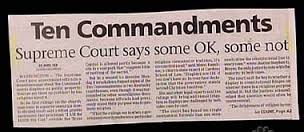
Headlines like the one above really irritate some people.  “How dare they pick and choose?!”  But be honest.  We all pick and choose.  Who among us obey all 613 commands of the Mosaic law?  That’s right.  Some people believe that the Law is just the Ten Commandments.  Actually, the Law of Moses contains 613 commandments covering everything from blood sacrifices to men’s haircuts to sewage disposal to charging interest on loans.

The New Testament seems to take a few steps further than the Supreme Court:

Romans 6:14: For sin shall no longer be your master, because you are not under the law, but under grace.

Romans 7:4: So, my brothers and sisters, you also died to the law through the body of Christ, that you might belong to another, to him who was raised from the dead, in order that we might bear fruit for God.  

Galatians 2:19: For through the law I died to the law so that I might live for God.

Romans 7:6: But now, by dying to what once bound us, we have been released from the law so that we serve in the new way of the Spirit, and not in the old way of the written code.

Galatians 3:24-45: So the law was our guardian until Christ came that we might be justified by faith.  Now that this faith has come, we are no longer under a guardian

Colossians 2:14: ...having canceled the charge of our legal indebtedness, which stood against us and condemned us; he has taken it away, nailing it to the cross.

Hebrews 8:13: By calling this covenant “new,” he has made the first one obsolete; and what is obsolete and outdated will soon disappear.

Hebrews 10:9:  He sets aside the first to establish the second.

Romans 10:4:  For Christ is the end of the law for righteousness to everyone who believes.

Ephesians 2:14-15:  For he himself is our peace, who has made us both one and has broken down in his flesh the dividing wall of hostility by abolishing the law of commandments expressed in ordinances…

Not under law; died to the law; dying to what once bound us;  released from the law; no longer under a guardian; nailed to the cross; obsolete; set aside; Christ is the end of the law; abolishing the law.  Strong words.  Clear communication.

I can hear the objections: “But wait!  What about Matthew 5:17-19? Take that!  See, the law is still in effect.  We’re still supposed to follow it.”  Jesus said,  Do not think that I have come to abolish the Law or the Prophets; I have not come to abolish them but to fulfill them. For truly I tell you, until heaven and earth disappear, not the smallest letter, not the least stroke of a pen, will by any means disappear from the Law until everything is accomplished…”

Well, this is confusing.  Paul says Jesus abolished the law (Ephesians 2:15) and Jesus says he has not come to abolish the law!  What’s up?

Back it up.  Jesus did say the law would disappear when two things happened: 1. heaven and earth will disappear,  and, 2. everything is accomplished.   When those two things happen, the law is out of here! It’s gone. So long.  See ya later.  Gone like Roger Daltrey’s shirt.

#2 – Everything is accomplished –  At a key moment Jesus announced that everything was finished – at that moment. “It is finished.” John 19:30

#1 – Heaven and earth will disappear – Well, that obviously means a literal heaven and earth disappearing. Doesn’t it?  Maybe not.
If “heaven and earth” refers to a literal, physical heaven and earth, then, yep, the Law of Moses has not passed – it’s still alive and kicking.  But I believe that “heaven and earth” is a metaphor for political or national systems.  Take a look at these references:
Isaiah 1:1-2; Isaiah 24:3-6; Isaiah 34:3-5; Hebrews 12:26-28; Matthew 24:29; Luke 21:32-33

In the last two references Jesus wasn’t speaking of a physical heaven and earth but of a system – a way of doing things – the Mosaic Covenant with its laws, sacrifices, priesthood, tabernacle (Hebrews  9:8-11).  Jesus was speaking of the fall of Jerusalem that would happen about 40 years later in A.D. 70 when God removed the things that could be shaken and in their place gave His people a Kingdom which can never be moved (Hebrews 12:18-28).

Luke 21:32-33 contains the same elements as Matthew 5:17-19 – the disappearance of heaven and earth and everything accomplished.

Jesus and Paul are not in conflict with one another.  Heaven and earth – the system under the Mosaic covenant disappeared bringing on the abolishment of the law!!!!

So, I guess we can just let ourselves go wild?!  God, as always, has this covered;
So Christ has truly set us free.  Now make sure you stay free, and don’t get tied up again in slavery to the law…For you have been called to live in freedom … but don’t use your freedom to satisfy your flesh.  Instead, use your freedom to serve one another in love…So I say, let the Holy Spirit guide our lives.  Then you won’t be doing what your flesh craves (Galatians 5:1-16).

The law or the Holy Spirit?  What is our choice?

What About the Law?

Image

Over the last few weeks I have followed the discussion in the blogosphere concerning the role of the Old Testament law.  The question centers on a variation of Moses’ statement made in the above “Speed Bump” cartoon: “What part of the law is meant for us?”

People answer that question in one of three ways:
1. All of it.  2. Some of it.  3. None of it.

Let’s look a bit more closely at the three options:

1. Think hard about this before you say, “Of course all of it is meant for us! God said it so I’ll do it!”  Placing yourself in that group means that you’ve cleaned all of the cotton-polyester     clothes out of your closet – Leviticus 19:19; Deuteronomy 22:11; that you order your     steak “well-done,”  Leviticus 19:26; that you never cut your hair, Leviticus 19:27 (If only I would have used that verse during the great hair-debates of the 60s); and other behaviors that just don’t make much sense to us today.

2. The “some of it” group is huge.  This view breaks the law into three categories:
a. The moral law – declares how man should live.
b. The civil law – describes the legal structures for the ancient nation of Israel.
c. The ceremonial law – declares how Israel was to worship.

The “some of it” group says that only the moral law is “meant for us.”  The ceremonial     and civil laws were meant only for ancient Israel.   So, “Don’t murder” still applies but not the “no haircut” rule. This view is the one held by most Christians today.

3.   The “none of it” answer is the one that I believe is the right one.  To explain why will take a lot longer than one post! Let’s jump in.

*The Bible gives no hint of different “kinds” of law.  It’s all one.  Joshua speaks of the Law as one unit when he writes in Joshua 1:8, “Keep this Book of the Law always on your lips; mediate on it day and night, so that you may be careful to do everything written in it.  Then you will be prosperous and successful.”

It sounds like Paul does the same thing in Galatians 5:3, “Again I declare to every man who lets himself be circumcised that he is obligated to obey the whole law.”

No division by either Joshua or Paul.

*How do you pick and choose?  It gets confusing.  “Love your neighbor as yourself” (Leviticus 19:18) is followed in the very next verse by the law “do not wear clothing woven of two kinds of material.”  Should verse 18 be seen as “meant for us” while verse 19 is dismissed as nonapplicable?   The text gives no indication that any kind of hermeneutical shift has taken place between the two verses.

One of the clearest examples of the confusion in picking which law to keep and which to dismiss is the 4th commandment out of the Big 10 – Exodus 31:14-15 – the one about keeping the Sabbath.  The “some of it” group says that the 10 Commandments are part of the Moral Law, and thus, meant for us today. Wouldn’t most people believe that we are to keep the 10 Commandments?  Yes, but do we really keep the Sabbath?

“Sure. I go to church on Sunday.”

That’s great.  But that’s not keeping the Sabbath.  If we’re going to keep the law, we can’t alter it or adjust it.  The Sabbath is the seventh day which is Saturday.  Keeping the Sabbath didn’t have anything to do with going to church.  It was having a day of total rest.  No work, no chores, no cooking, no traveling.

“But aren’t there passages that say we don’t need to observe the Sabbath anymore?” Yep.  Take a look at Romans 14:5, “In the same way, some think one day is more holy than another day, while others think every day is alike.  You should be fully convinced that whichever day you choose is acceptable.”  Want another?  “So, don’t let anyone condemn you for what you eat or drink, or for not celebrating certain holy days or new moon ceremonies or Sabbaths.  For these rules are only shadows of the reality yet to come.  And Christ himself is that reality.” Colossians 2:16-17

So are we required to keep the Sabbath?  It doesn’t sound like it.  So I guess that means we are to obey the Nine Commandments…right?  Confusing.

Paul may clear it up a bit.
“Why, then, was the law given at all? It was added because of transgressions until the Seed to whom the promise referred had come.  The law was given through angels and entrusted to a mediator.”  Galatians 3:19

So, Phillip, what do we do with the 10 Commandments?  We follow many of these same commands like “no adultery”, “no murder”, etc.  But we don’t follow them because they are the 10 Commandments.  We follow them because we follow the way of love – the way of Christ who is the Seed who has come.

“For the entire law is fulfilled in keeping this one command: ‘Love your neighbor as yourself.’… But if you are led by the Spirit, you are not under the law.”  Galatians 5:14,18

Love, as experienced and expressed in Jesus is what is meant for us.

“I Feel Good”

Image

The word on the street is that the church I pastor is “just a feel-good church.”  I guess that makes me “just a feel-good pastor.”  It wasn’t meant to be a compliment.  So, it’s OK for James Brown (I Feel Good) or Chuck Mangione (Feels So Good) or Three Dog Night or Flo-Rida (Good Feelin’) to “feel good” but it’s not good for people who go to church to “feel good?”  I don’t get it.

The fella who passed on to me the word he had heard had this commentary: “Who wants to feel good after going to church?”   The kind of church I want to be a part of is one that makes you feel terrible!”  I like that fella.

Why do we feel threatened by “feeling good?”  What is in our theology that equates “feeling good” with “being bad”?  How many of you who grew up in church grew up thinking,  “If it feels good, it’s probably sin.”  That’s Jack LaLanne thinking, not Jesus thinking.  Do you remember Jack LaLanne?  He’s the father of the modern fitness movement.  One of his nutrition rules was, “If it tastes good, spit it out.” I guess his rule worked well.  He lived til he was 96.  Jesus seemed, though, to turn conventional wisdom upside down.  Gain by losing. Lead by serving.  Receive by giving.

So, what’s Jesus thinking when it comes to “feel-good” churches?   We get a clue from the name we’ve given the 4 New Testament biographies of Jesus – the Gospels – which means “Good News.”  This story of Jesus is “good” news, not “bad” news.  When I hear good news I usually feel good.

The sermon preached by the angel to the shepherds “watching their flocks” on the night of Jesus’ birth was certainly a “feel good” sermon.  Do you remember this line? “Do not be afraid.  I bring you good news that will cause great joy for all the people.”  Good news results in great joy.

Listen to Jesus himself:

“The Spirit of the Lord is on me, becasue he has anointed me to proclaim good news to the poor.  He has sent me to proclaim freedom for the prisoners and recovery of sight for the blind, to set the oppressed free, to proclaim the year of the Lord’s favor.”  Luke 4:18-19

“I must proclaim the good news of the kingdom of God to the other cities also; for I was sent for this purpose.”  Luke 4:43

“Come to Me, all who are weary and heavy-laden, and I will give you rest.  Take my yoke upon you and learn from Me, for I am gentle and humble in heart, and you will find rest for your souls. For my yoke is easy and My burden is light.” Matthew 11:28-30

People who “go off” on “feel-good churches” are implying that these churches are not teaching the truth because the truth is hard to swallow – it doesn’t feel good going down.

Let’s be clear: there are times when truth hurts.  As James Garfield said, “The truth will set you free but first it will make you miserable.”  For a bit more edgy version of this idea check out Gloria Steinem’s take: http://thinkexist.com/quotes/gloria_steinem/.  Jesus said some tough stuff- mostly to religious people.  In fact, here are the stats:  Going off on “sinners” – 0.  Going off on the “religious” – I can’t count that high.

“Pride, hypocrisy, insensitivity, judgmentalism, ”  are a few of the things in the Pharisees that Jesus called out.

I have concluded that it is not my job to make people feel good OR bad about where they are in their spiritual journey.  It is my job to show people Jesus and let Him, through the Holy Spirit, do what He does.

John said this about Jesus, “Out of his fullness we have all received grace in place of grace already given.  For the law was given through Moses; grace and truth came through Jesus Christ” (John 1:16-17).  Sometimes we’ll feel bad at church because we realize we’re not like Jesus.  But all the time we should feel good at church because we know that no matter what, Jesus loves us, He’s for us, and wants to express Himself through us.

That sounds good.  That is good.  That makes me feel good.

Image

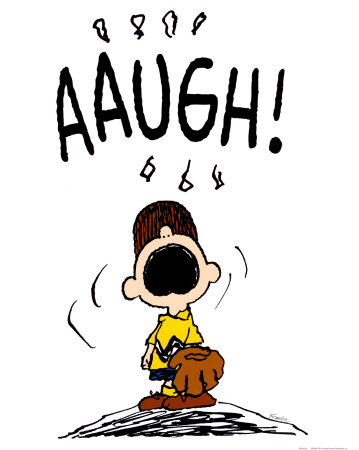
Baseball’s back!  Yes, I know the first game was last night, but Texas at Houston? Doesn’t feel right.  That seems more like an old Southwest Conference game than it does the first game of the MLB season.  For me, today feels like the first day.

I’ll be watching my beloved Cardinals tonight, unless I’m in the ER after playing in my first softball game in 20 years.  I guess I’m trying to reach back and find my youth. Not sure I can reach that far.

A couple of my favorite baseball quotes:

“It took me 17 years to get 3000 hits in baseball.  I did it one afternoon on the golf course.”  Hank Aaron

“If a tie is like kissing your sister, losing is like kissing your grandmother with her teeth out.”  George Brett (That doesn’t feel right either.)

There are lots of lessons to be learned from baseball. Here are a few:

Lesson 1:  Errors will occur. Over the course of the long season, every player makes errors -a misjudged fly, a bobbled grounder, a wild throw.  We all commit moral and spiritual errors.  Suppose our errors were counted and published every day? For Bill Bucker, his was more than just an error in the record book.

When baseball fans think of Bill Buckner they think of the  6th game of 1986 World Series, the Red Sox vs. Mets.  Mookie Wilson of the Mets grounds to first.  Red Sox first baseman, Bill Buckner hobbles over, bends down, but not far enough.  The ball goes through his legs.  This brought in Ray Knight from 2nd base and the Mets won Game 6. Of course, they went on to win the 7th game and the World Championship.  The error is now part of October.  Like fall foliage.  Everyone has forgotten about Buckner’s career:  22 seasons, 2700 plus hits, .289 avg.  All they remember is this error.  Red Sox fans won’t let him forget it.  The butt of jokes.  The topic of songs.  One sports jockey told this one: “Bill Buckner tried to commit suicide today. He jumped in front of the train. But it went through his legs.”  Buckner moved his family to Idaho.  Running away. It’s hard though to run away from your own memory.

Identified by his past.  Known by his error.  That’s the way of accusers. Have you been accused?  Accusers just won’t let up?  Maybe you’re an accuser?  You just won’t let up.  That’s not the way of Jesus. Hebrews 10:17; Hebrews 8:12; Jeremiah 31:34

Lesson 2: Comebacks are possible. Opening day, at Fenway, April 8, 2008.  The World Champion Boston Red Sox welcomed the exiled Bill Buckner back to Boston. With the crowd giving him a standing ovation, Buckner stood on the pitchers mound and with tears running down his cheeks, he threw out the first pitch.  Yeah, there is crying in baseball. We can come home.  Luke 15:20

Lesson 3: Team is necessary.  One of a ballplayer’s statistics is assists. The player who is directly involved in a play where another player gets a “put-out” is credited with an assist. On a larger scale, the nine players on a team have to depend on each other and work together in order to win. When the Yankee pitcher Lefty Gomez was asked the secret of his success, he replied: “Clean living and a fast outfield.” As a pitcher, he needed his outfielders.

We need each other.

When we hear the cry, “Play ball!” we can remember that baseball is more than a game to like, to love, or, for some, to turn off.  If we look hard enough, we will see in baseball, like all of life, lessons for living.

Image

I appreciate labels.  Since being diagnosed with celiac, I’m a label freak.  I carefully examine labels on everything from food to face soap. My health depends on it.

So, I should clarify.  I appreciate the proper place of labels.

Labels belong on products. Not people.  On products, labels are helpful.  On people, labels are hurtful.  On which side of “label slapping” have you been? I’ve been on both – giving and receiving.

On the receiving side, the label of choice was “liberal.”  “Phillip is just a liberal,” so it was said.

I don’t like people labels. Here are a few reasons why:

* Labels don’t do much to enhance the conversation.  Fact is, labeling seems to stop any conversation. Someone has said (experts are still looking for the source), “Great minds discuss ideas; average minds discuss events; small minds discuss people.” Ouch.

* Once we label someone, we start to see only the label.  We look for information that confirms the label that we have placed on a person.

Want a “for instance”?  President Ford was a great athlete, playing for two championship football teams at the University of Michigan, and being selected an All-American.   Yet, after he took a tumble or two on the ski slopes and then slipped one rainy day coming down the stairs of Air Force One, he developed the reputation of being a klutz.  Then when Chevy Chase impersonated Ford as a klutz on SNL, the label stuck.  The joke was that VP Rockefeller was just a banana peel away from the Presidency.

Or this example:
Stephen Colbert interviewed Oregon Congressman Earl Blumenauer:
Stephen Colbert: “Would it be safe to say you’re a liberal?”

Con. Blumenauer: “It depends on the issue.  Because I’m also working with some of my more conservative friends to try to eliminate sugar subsidies.  Is that liberal or conservative?”

Stephen Colbert: “It’s liberal.”

Con. Blumenauer: “You think?”

Stephen Colbert: “I do.”

Con. Blumenauer: “Why?”

Stephen Colbert: Cause you support it.”

People will literally ignore anything that isn’t in line with the label they have given to a person.

It’s tough to live outside of the label.

Maybe living with a liberal label isn’t so bad.  Some of the evangelical world’s most respected and quoted leaders hold views that would, by some people, earn them the same label.

Tim Keller, “I think Genesis 1 has the earmarks of poetry and is therefore a song about the wonder and meaning of God’s creation…There will always be debates about how to interpret some passages – including Genesis 1.  But it is false logic to argue that if one part of Scripture can’t be taken literally then  none of it can be.” Tim Keller

C.S. Lewis, “There are people in other religions who are being led by God’s secret influence to concentrate on those parts of their religion which are in agreement with Christianity, and who thus belong to Christ without knowing it.  For example a Buddhist of good will may be led to concentrate more and more on the Buddhist teaching about mercy and to leave in the background (though he might still say he believed) the Buddhist teaching on certain points.  Many of the good Pagans long before Christ’s birth may been in this position.”  Mere Christianity

Dietrich Bonhoeffer, “The Bible remains a book like other books.  One must be ready to accept the concealment within history and therefore let historical criticism run its course.  But it is through the Bible, with all its flaws, that the risen one encounters us.” Christ the Center  

Wow.  These guys have made some statements that certainly lie outside the boundaries of some theological systems. In some circles they’d be labeled liberals. Yet, we give their books to people sruggling with their faith. We quote them extensively. We hold them up as examples of Christian maturity and devotion.  I’m all for it. I’m glad we do.  But it begs the question: Why do these guys get a pass and others don’t?

Lessons in a Barbershop

Image“People were also bringing babies to Jesus for him to place his hands on them.  When the disciples saw this, they rebuked them.”  Luke 18:15

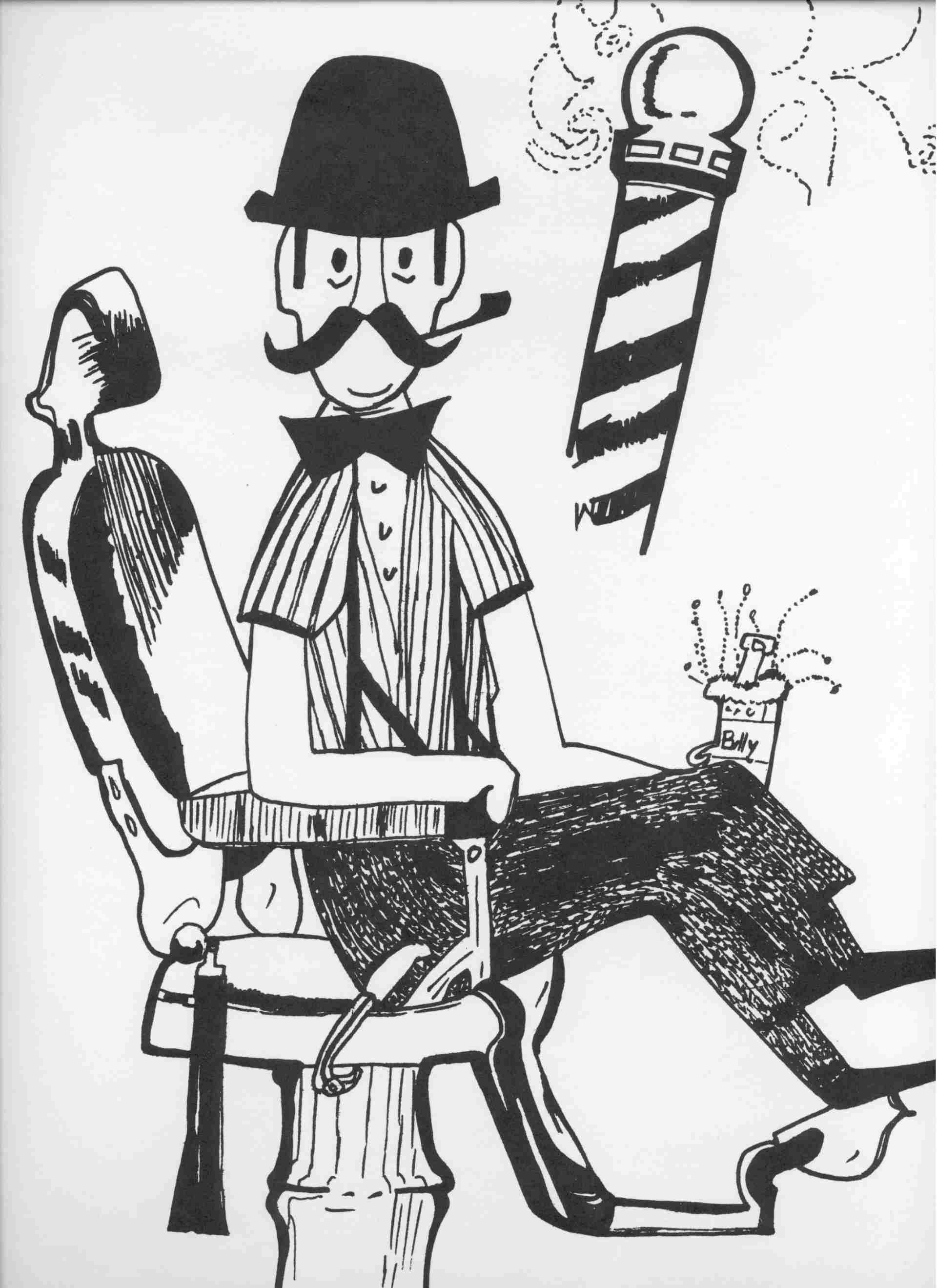
It was Saturday morning at the barbershop.  Packed out.   A family of four walked in. Mom and dad took the seats beside me. The two boys, I’m guessing around 4 and 6 years old, took a seat on the floor beside the table covered with the day’s newspaper, your typical array of barbershop magazines and a few children’s books.  The youngest boy found Dr. Seuss’ Green Eggs and Ham and a big smile crossed his face.  He hurriedly turned to the first page.   Then it began.  The brother-brother dance.  Two kids wanting the same book.  Parents, we’ve all been there.  How would these parents negotiate the tug of war?

“Give the book to your brother.  You don’t know how to read.”  Mom instructed the little guy.

“Yes, I do.  I’m reading it with my mind!” the young reader replied.

I thought, “How cute is that?”

Mom didn’t think it was so cute.  “No, you’re not,” she said. “You’re just looking at the pictures.”

“Mom,” he protested, “I’m reading it with my mind.”

While this “back and forth” went on, the little boy’s frustration as well as mine, grew.  Not being able to keep my nose out of other people’s business, I stepped in.

Leaning forward, I offered this suggestion, “Hey guys, how about if I read the book to both of you? I’ll scoot over and one of you can sit by me and the other can sit on your mom’s lap.”

“Yeah!.” the youngest one shouted and plopped himself beside me in my chair while his older brother climbed onto his mom’s lap.  The older brother lost interest but the youngest was into it.  I read a line, “I am Sam.” Before I could read the next line, the little fella said, “I am Sam, Sam I am.” This pattern continued.  I’d read one line, and he’d repeat the next.  “Would you like them in a house?” He’d follow with, “Would you like them with a mouse?”

How about that?  He really was reading with his mind!

It was my turn for a haircut. We closed the book and I got settled in the barber chair.  Several times, the little fella would make eye contact with me and wave.  I’d work my hand out from under the cape and wave back.  Haircut done, barber paid.  As I went to get my coat, I was waved over by that innocent little hand.   Green Eggs and Ham was opened to the last page we had read.  “Will you finish the book?” he asked.  “You bet,” I answered. “I can’t wait to see how it ends.”

“You’re a good thinker and reader,” I said as we closed the book. I gave the kid a brief hug around the shoulder, walked out of the barber shop into the cold air, warm tears welling up in my eyes.

We know the power of touch.  It feels good to us. It is good for us.  A touch in Jesus’ time was much more.  It was the conferring of a blessing – a statement of acceptance and affirmation.

That’s it.  Kids want and need acceptance and affirmation.  It is food for the soul and is as necessary as vegetables for the body.  My new barbershop friend just needed a “touch.”

How many “touches” am I giving each day?
How many opportunities are there that I have missed?
How many people have I ignored? In my own family? In my community?

Best haircut I’ve had in a long time.

“Accusation is Not Proof”

It’s old news now – Mark Driscoll, founding pastor of Mars Hill Church in Seattle, tweeted about President Obama during the Inauguration.

Image

I’ve stared at this tweet off and on, not knowing how to respond. Not knowing if I should respond.  “Some thoughts are better left unexpressed,” I’ve told myself. “Better to keep your mouth closed and be thought a fool than to open it and remove all doubt,” advice I obviously have not followed in the past.

News came to me this week, however, that made the tweet personal.  Driscoll lobbed a bomb at the President.  The pastor, along with all Americans, has a right to criticize our leaders and their policies.  It’s the American way.  No problem there.  Driscoll’s tweet though was the delivery of a spiritual slam.

“…who today will place his hands on a Bible he does not believe to take an oath to a God he likely does not know.”

Several months ago a message began circulating that “Phillip doesn’t believe the Bible.”  Like the Energizer Bunny the message keeps going and going.  I heard it again this week. I thought, “Really?”

The charge came as a result of a teaching I gave in September 2012.   I’ve listened to the audio of that teaching three times  – I never said what was said I said.

I did say this: “We can’t build our faith on the foundation of the Bible, but on the person of Jesus” (1 Corinthians 3:11; 1 Corinthians 15:1-4, 1 Corinthians 15:14)

And I said the following in response to an earlier comment from another teacher at the same seminar concerning inerrancy: “Every inerrantist I know, or have read, believes that only the original manuscripts are inerrant.  So if you base your trust in the Bible on its inerrancy then you won’t be able to trust this book (the one I’m holding in my hand), because the Bible you have right here is not the original manuscript.  And if you base your trust in the Bible on whether or not it is inerrant then you can’t trust what you have here…”

The claim is made by those who hold an inerrantist view, that the trustworthiness of the Bible stands or falls with inerrancy.  If the Bible contains any real errors it cannot be trusted.  Then there is the admission that every Bible that exists probably contains errors.  Only the original manuscripts can be considered perfectly inerrant.

So…think along with me…if the Bible’s trustworthiness is based on inerrancy- as defined as “without error” –  and only the original manuscripts – which no one has – are inerrant, then that does not bode well for the trustworthiness of the Bible we do have.

That is why I like and hold the definition of inerrancy given by John Piper – “Perfect with regard to purpose.” The Bible’s main purpose is transformation, not information (2 Timothy 3:16), and it’s unfortunate that so many people spend their time arguing over the “information” part.  The Bible is absolutely trustworthy to do what it is intended to do.

Back to the tweet.

I do not know why the President is accused by Driscoll of not believing the Bible.  I do know that in the words of Edward R. Murrow, the pioneer of television news reporting, “Accusation is not proof.”

Yeah, it’s a bit personal.

Holiness? “Love God, then do what you please.”

Let’s continue thinking about holiness. There seems to be a conflict.  Christianity Today asks the question, “Do American Christians Need the Message of Grace or a Call to Holiness?”  What is your answer?  My answer has not always been warmly received.  I’m still trying to figure out why. Personally, grace is like ice-cream. You can’t have too much.
Maybe Paul clears up the confusion when he tells us to “put on the new self, created to be like God in true righteousness and holiness.” (Ephesians 4:24)  “True holiness?”  Did you catch that?  If there is true holiness, there must be false holiness.  Maybe we’re all hung up on a holiness that is false.

False holiness is about keeping Christian rules.  
False holiness is about keeping away from bad influences.

See any problem with the above definitions of holiness?  One big one!  Jesus.  Jesus was holy.  No question about that.  Yet, Jesus broke quite a few religious rules – so many and so often that the religious leaders put him to death. Maybe Christianity is not about keeping the rules.

Keeping away from bad influences? Jesus kind of messes with that one as well. “A friend of sinners” (Matthew 11:19), Jesus was called.  He hung out with and even ate with people who were “bad influences.” The Gospel writers didn’t say that Jesus tolerated sinners, or that he made an allowance for them to be in his gathering.  It doesn’t say that he tract-bombed them and then ran. No, the writers tell us that he was a friend of sinners.  He went to their houses, talked with them over wine (not grape juice).

For those who follow a false holiness, holiness requires them to keep away from certain people. For Jesus, holiness compelled him to reach out to those same people.

So, no one lived a holier life than Jesus, yet he broke religious rules and the irreligious considered him to be their friend.

False holiness is controlling my sin.   Borrowing the term from Dallas Willard, holiness is all about “sin management.”   In this view of holiness, the gospel is little more than a list of good behaviors. Christianity is about being good and making sure other people are good.  We focus on our behavior and even more so at times, other’s behaviors.  Result? We turn into guilt-ridden, judgmental, list-makers.  And the sins keep popping up like “Whack-a-mole.”

There’s a better way.  True holiness.  Think about this until next time:  What was the first sin about?  A broken rule or a broken relationship?  Did God really care about a piece of fruit? When Adam and Eve broke the rule they were demonstrating that they didn’t trust God.  They doubted God’s love and goodness.

St. Augustine once said, “Love God, then do what you please.” Paul puts it like this: “For when we place our faith in Christ Jesus, there is no benefit in being circumcised or being uncircumcised (Fill in your own rule here).  What is important is faith expressing itself in love.” Galatians 5:6

“Faith (dependence on Jesus), expressing itself in love.”   Now, that’s true holiness.