Lessons in a Barbershop

Image“People were also bringing babies to Jesus for him to place his hands on them.  When the disciples saw this, they rebuked them.”  Luke 18:15

It was Saturday morning at the barbershop.  Packed out.   A family of four walked in. Mom and dad took the seats beside me. The two boys, I’m guessing around 4 and 6 years old, took a seat on the floor beside the table covered with the day’s newspaper, your typical array of barbershop magazines and a few children’s books.  The youngest boy found Dr. Seuss’ Green Eggs and Ham and a big smile crossed his face.  He hurriedly turned to the first page.   Then it began.  The brother-brother dance.  Two kids wanting the same book.  Parents, we’ve all been there.  How would these parents negotiate the tug of war?

“Give the book to your brother.  You don’t know how to read.”  Mom instructed the little guy.

“Yes, I do.  I’m reading it with my mind!” the young reader replied.

I thought, “How cute is that?”

Mom didn’t think it was so cute.  “No, you’re not,” she said. “You’re just looking at the pictures.”

“Mom,” he protested, “I’m reading it with my mind.”

While this “back and forth” went on, the little boy’s frustration as well as mine, grew.  Not being able to keep my nose out of other people’s business, I stepped in.

Leaning forward, I offered this suggestion, “Hey guys, how about if I read the book to both of you? I’ll scoot over and one of you can sit by me and the other can sit on your mom’s lap.”

“Yeah!.” the youngest one shouted and plopped himself beside me in my chair while his older brother climbed onto his mom’s lap.  The older brother lost interest but the youngest was into it.  I read a line, “I am Sam.” Before I could read the next line, the little fella said, “I am Sam, Sam I am.” This pattern continued.  I’d read one line, and he’d repeat the next.  “Would you like them in a house?” He’d follow with, “Would you like them with a mouse?”

How about that?  He really was reading with his mind!

It was my turn for a haircut. We closed the book and I got settled in the barber chair.  Several times, the little fella would make eye contact with me and wave.  I’d work my hand out from under the cape and wave back.  Haircut done, barber paid.  As I went to get my coat, I was waved over by that innocent little hand.   Green Eggs and Ham was opened to the last page we had read.  “Will you finish the book?” he asked.  “You bet,” I answered. “I can’t wait to see how it ends.”

“You’re a good thinker and reader,” I said as we closed the book. I gave the kid a brief hug around the shoulder, walked out of the barber shop into the cold air, warm tears welling up in my eyes.

We know the power of touch.  It feels good to us. It is good for us.  A touch in Jesus’ time was much more.  It was the conferring of a blessing – a statement of acceptance and affirmation.

That’s it.  Kids want and need acceptance and affirmation.  It is food for the soul and is as necessary as vegetables for the body.  My new barbershop friend just needed a “touch.”

How many “touches” am I giving each day?
How many opportunities are there that I have missed?
How many people have I ignored? In my own family? In my community?

Best haircut I’ve had in a long time.

“Accusation is Not Proof”

It’s old news now – Mark Driscoll, founding pastor of Mars Hill Church in Seattle, tweeted about President Obama during the Inauguration.

Image

I’ve stared at this tweet off and on, not knowing how to respond. Not knowing if I should respond.  “Some thoughts are better left unexpressed,” I’ve told myself. “Better to keep your mouth closed and be thought a fool than to open it and remove all doubt,” advice I obviously have not followed in the past.

News came to me this week, however, that made the tweet personal.  Driscoll lobbed a bomb at the President.  The pastor, along with all Americans, has a right to criticize our leaders and their policies.  It’s the American way.  No problem there.  Driscoll’s tweet though was the delivery of a spiritual slam.

“…who today will place his hands on a Bible he does not believe to take an oath to a God he likely does not know.”

Several months ago a message began circulating that “Phillip doesn’t believe the Bible.”  Like the Energizer Bunny the message keeps going and going.  I heard it again this week. I thought, “Really?”

The charge came as a result of a teaching I gave in September 2012.   I’ve listened to the audio of that teaching three times  – I never said what was said I said.

I did say this: “We can’t build our faith on the foundation of the Bible, but on the person of Jesus” (1 Corinthians 3:11; 1 Corinthians 15:1-4, 1 Corinthians 15:14)

And I said the following in response to an earlier comment from another teacher at the same seminar concerning inerrancy: “Every inerrantist I know, or have read, believes that only the original manuscripts are inerrant.  So if you base your trust in the Bible on its inerrancy then you won’t be able to trust this book (the one I’m holding in my hand), because the Bible you have right here is not the original manuscript.  And if you base your trust in the Bible on whether or not it is inerrant then you can’t trust what you have here…”

The claim is made by those who hold an inerrantist view, that the trustworthiness of the Bible stands or falls with inerrancy.  If the Bible contains any real errors it cannot be trusted.  Then there is the admission that every Bible that exists probably contains errors.  Only the original manuscripts can be considered perfectly inerrant.

So…think along with me…if the Bible’s trustworthiness is based on inerrancy- as defined as “without error” –  and only the original manuscripts – which no one has – are inerrant, then that does not bode well for the trustworthiness of the Bible we do have.

That is why I like and hold the definition of inerrancy given by John Piper – “Perfect with regard to purpose.” The Bible’s main purpose is transformation, not information (2 Timothy 3:16), and it’s unfortunate that so many people spend their time arguing over the “information” part.  The Bible is absolutely trustworthy to do what it is intended to do.

Back to the tweet.

I do not know why the President is accused by Driscoll of not believing the Bible.  I do know that in the words of Edward R. Murrow, the pioneer of television news reporting, “Accusation is not proof.”

Yeah, it’s a bit personal.

Holiness and Grace: Like Peanut Butter and Jelly

“Do American Christians Need the Message of Grace or a Call to Holiness?”  That is a question recently posed for discussion by Christianity Today.  The question hits home.  One comment directed my way over the last few years was,  “Phillip, you need to preach more on holiness and less on grace.”   That statement probably reflects more on my poor preaching than anything else.  I was glad to see through this article that the tension between grace and holiness is not isolated to my little world.

The desire is right – we want to live “holy lives.”  But what does that mean? And how do we do it?  Today, let’s talk what it means.

I’m telling my age, but I can’t hear the word “holy” without thinking of the old Batman TV show from the 60s.  Before the dark, deep, Batman movies of today, there was the campy, cheesy TV Batman with his side-kick Robin.  Each week the duo would fight the colorful criminals of Gotham City and each week Robin would come out with a new take on “holy” – “Holy Caffeine,” “Holy slipped disc,” “Holy popcorn,” “Holy hole in a donut.”  Yes, this was entertainment.

I wonder, are we as off the mark as to the meaning of holy as is Robin?  Most of us think that being holy is being good.  Being holy is being better than everybody else.   Holiness is doing this or not doing that.  Holiness is following the rules.  Sermons on holiness are often punctuated with words like “should” and “must.”

The word used by Biblical writers translated “holy” basically means “set apart.” To be holy is to be set apart by God, to God, for God.  Think of it like this: I am holy to Denise.  I am set apart to and for her.  No more dating around for me.  The day I entered Christ,   God set me apart to Him.  He set me apart from my old nature and gave me a new nature (Romans 6:6). He made me holy. 1 Corinthians 3:16 says that your body is the temple of the Holy Spirit. Verse 17 says the temple of God is holy and you are that temple.”

My body is a temple?  As the country song goes, “She treats her body like a temple. Hey, I treat mine like a honky tonk.”

Pretty outrageous statement by Paul, isn’t it?  I am a temple. God lives in me.  And this temple is holy.  I don’t have to try to be holy.  I already am.  God said so.

A little cocky, calling myself holy? A little full of myself, you think?    Full of something for sure.  What makes a person holy is Jesus.  Paul put it like this, “It is because of God that you are in Christ Jesus, who has become for us wisdom from God – that is, our righteousness, holiness and redemption.” 1Corinthians 1:30

You remember the Corinthian Christians, don’t you? They were like characters in a country song – really messed up – backbiting, picking sides, sleeping around, you name it they probably did it.  Yet, Paul starts his letter to them like this, “To the church of God which is at Corinth, to those who have been sanctified in Christ Jesus, saints by calling…” 1 Corinthians 1:2
The point: Our behavior does not determine who we are.  Their holiness didn’t have anything to do with what they did or didn’t do.  It was God’s doing and their position in Christ that made them holy (See 1Corinthians 1:30 again).

Do you see where grace comes in? Do you see how grace is connected to holiness?
Grace and holiness – like peanut butter and jelly.

Grace is the simple reality that Jesus did everything. We are saved through grace.  We are holy through grace.  To preach holiness without grace is behavior modification.

Christian growth does not happen by behaving better but by believing in bigger, deeper, brighter ways what Christ has already done for us.

What is holiness?  It is Jesus.  He is the definition of holiness and by the working of God’s grace, he has become our  holiness too.

God Loves a Cheerful Tipper

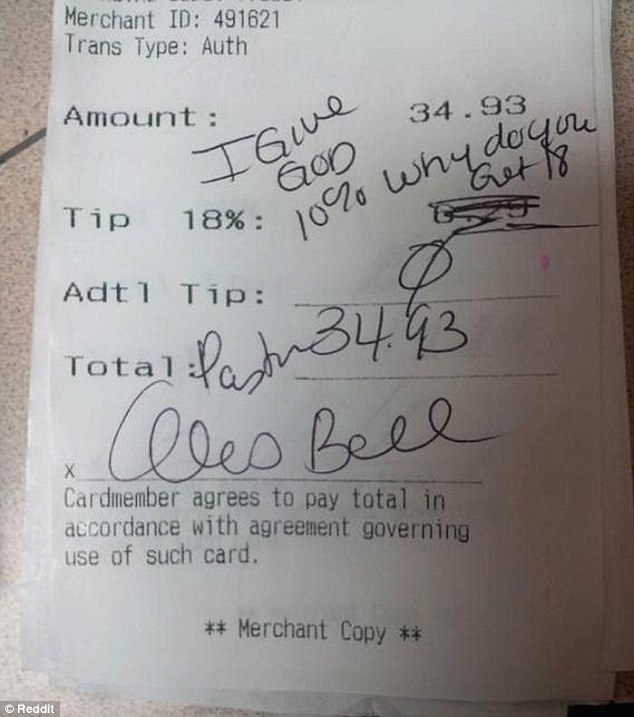
The subject of Christians and tipping is back in the headlines thanks to the pastor in St. Louis who not only left no tip but threw in a sanctimonious sermon to top it off.  In case you haven’t heard here’s a brief synopsis:

Pastor and friends enjoy a good meal at Applebee’s accompanied by excellent service.
Pastor receives a check with an automatic 18% “six or  more” gratuity added to the total.
Pastor is not happy. Pastor crosses out the $6.29 tip, writes instead “0” and adds this zinger: “I give God 10%. Why do you get 18?”
Pastor signs the receipt with “Pastor.”

Later that day, a waitress who had not served the pastor took a picture of the receipt and posted it online with a note reading, “My mistake…I’m sure Jesus will pay for my rent and groceries.” The internet went crazy.

After seeing her receipt, complete with her signature on the internet, the pastor complais to Applebee’s which promptly fires the poster.

The pastor apologizes saying that her actions show a “lapse in my character and judgment.” She continues, “My heart is really broken.  I’ve brought embarrassment to my church and ministry.”  You think? Another case of a Christian gone bad?

I’m not going to come down hard on the pastor.  While I do give a generous tip to servers I’m not always so generous in the kindness department to telemarketers, tech support people, and a few others.  Nope.  I’m not in a position to throw rocks.

The pastor is right.  She did bring embarrassment to her church, ministry, and, I think, to Jesus.  How about us?  Anything we’re doing to embarrass Jesus?

According to studies, God has a flock full of cheapskates.

The joke is old and a “groaner” but true nonetheless, “What’s the difference between Christians and canoes? Canoes tip.”

A 2012 study by Cornell University tipping expert Michael Lynn showed that Jews and people with no religion tip better than self-identified Christians.  The personal stories of servers being stiffed by Christians are sad.  To top it off, instead of leaving money, some leave a cheesy gospel tract – a practice called tipping with a tract.

One server got excited when he saw what he thought was a $10 bill under a plate  Instead, it was a fake bill with these words, “Some things are better than money.”  Turn it over and it reads, “like your eternal salvation, that was bought and paid for by Jesus going to the cross.”  The server posted photos of the note with these words, “I have never been more atheist.”  I don’t think the tract worked. I wonder how many people have given their lives to Christ because a customer tipped them with a tract instead of money?

“Everybody at Chili’s hates waiting on Christians,” says one server.

“I believe there is a group called c.a.t.s. that congregates every Sunday after church at the restaurants of their choice and it stands for christians against tipping servers.”

“No one wants the church crowd,” writes Amanda, a server in Iowa: “they don’t tip.”

Some restaurant experts say that Sunday is famous for having the highest food sales but the lowest tips.

So next time we go out to eat, get a call from a telemarketer, or talk to a rep on the phone about a problem, I’ll ask myself:
How can I preach about an extravagant, grace-giving God and be stingy?
Am I letting Jesus speak through me?  Matthew 5:16, 1 Peter 2:12
Am I seeing Jesus in people?  Matthew 25:40
Image

The Theology of Ray Lewis

God was a major player in last night’s Super Bowl game between the Baltimore Ravens and the San Franciso 49ers.  According to one of the commercials, God made a farmer to sell Ram trucks. And according to Ray Lewis, God was cheering for the Ravens.

I’m not a big fan of the 49ers (I’m still upset over  “The Catch” of 1982 when Montana connected with Dwight Clark in the final minutes, beating the Cowboys), the Ravens (I don’t know why…I’m just not), nor Ray Lewis.  I am, though, a big fan of Paul Harvey and God.

The commercial was an appropriate hug of America’s farmers, delivered by Paul Harvey, taken from a 1978 speech at the Future Farmer’s of America convention.  Nothing against Chrysler, I’ve driven one, but I don’t think God gave us farmers so we’d buy a truck.

And then there’s Ray Lewis, the very talented and out-spoken linebacker for the Ravens.  He often wears his Christianity on his jersey so it was no surprise that in his post-game interview with Jim Nantz, Lewis gave a shout out to God, “It’s simple: when God is for you, who can be against you?”  Really Ray?

So God is for you and the Ravens but against the 49ers? God is for brother John and not brother Jim?  God is for the Raven fans and against the 49er fans? Did God blind the eyes of the officials on that 4th down play at the end of the game so that they missed the obvious interference?

Is this how God works?  Ray and a bunch of Americans believe so.    A survey by the Public Religion Research Institute out last week found that more than half of Americans believe “God rewards athletes who have faith with good health and success.”  Asked if they believe God plays a role in who wins, 27% of Americans said “yes.”

On its cover last week, Sports Illustrated asked the question, “Does God Care Who Wins the Super Bowl”

The question of God’s role in sports is even seen in Peanuts:
Charlie Brown is caddying for Snoopy: “I find it strange that the golfing gods never allowed you to make a hole-in-one.  I wonder what that means?”

Snoopy: “It means we need some new golfing gods.”

If God influences which teams win championships and He rewards athletes who have faith with success, then God’s favorite team must be the New York Yankees (27 world championships) and He must really not like the Cubs.  And what about Tim Tebow?  Where did his faith get him?  Banished from the Broncos and now the Jets.

How does God work?  Does “winning” mean God is pleased with us while “losing” means that God is displeased with us? We may not admit it but we believe it.  We secretly judge people who are struggling financially or experiencing some kind of trouble because we think they must not be right with God. When it happens to us we think, “If I were a better Christian, this wouldn’t be happening.”  “Bad things happen.   I must have been bad.” “Good things happen.  I must have been good.” Ray Lewis must have been good.    Colin Kaepernick of the 49ers must have been bad.

When someone who is bad gets something good we are confused and angry because he or she didn’t earn it.  That’s bad theology.  Here’s good theology.  When we were bad, God did something good for us.

“When we were sinners, God loved us…” Romans 5:8

We’ve been taught that the fear of God’s wrath is what brings us to Him and to repentance.  That’s bad theology.  Here’s good theology:

“There is no fear in love.  But perfect love drives out fear.”  1 John 4:18

“But when the kindness and love of God our Savior appeared, he saved us.  It wasn’t because of the good things we had done.  It was because of his mercy.” Titus 3:4-5

God’s kindness is intended to turn you from your sin.” Romans 2:4

God is the major player in our lives.  God is for everyone, not desiring that any should perish 2 Peter 3:9.

Image

Good God, Bad God part 3

In answering the question, “Is the God of the New Testament different than the God of the Old Testament?”, let’s ask this, “Is the Old Testament different than the New Testament?”; “Are there changes from the Old to the New?”

Well, duh.  The first clue in answering the question is the name given to each part of the Bible – “Old” and “New.” The “old” has changed so it is called “new.” Old way, new way.  Old contract, new contract.

Look at some changes between the Old and the New:

A change in the priesthood: Hebrews 7:12 – “For when there is a change of the priesthood there must also be a change of the law.”  According to God’s law, priests had to come from the tribe of Levi: Deuteronomy 18:1.  Uh oh, We’ve got a problem.  Jesus came from the tribe of the Judah, not Levi: Hebrews 7:14.  How did he get to be priest?  God obviously did something different. Something changed.

A change in the agreement:  2 Corinthians 3:6, “He has made us competent as ministers of a new covenant – not of the letter but of the Spirit; for the letter kills, but the Spirit gives life.”  See also, Hebrews 7:18-19; Hebrews 8:13 where the writer says the “old is obsolete.”

A change in sacrifice: Hebrews 10:9, “He abolishes the first in order to establish the second.”

A change in ethics: Exodus 21:24 and Leviticus 24:20 give us the “law of retaliation” – “eye for an eye.”  Jesus radically changed this law in Matthew 5:38-42 with His “turn the other cheek” ethic.

Peter experienced some of this “change” himself.  Before Acts 10, Peter could not eat Mac’s Sausage Biscuit. Nor could he eat “endless shrimp” at Red Lobster.    Why do we not lobby for capital punishment when church members run around on their mates Deuteronomy 22:22? Why does no one think twice of me preaching with glasses Leviticus 21:17-21?

Something has changed.  Who? What?

The reason Peter could eat a ham sandwich or toss around the pig skin is because God changed His law Acts 10:15.

In Sunday School I was introduced to a Bible interpretation principle called “progressive revelation.” Progressive revelation means that God progressively revealed more truths about various subjects. The Bible wasn’t dropped out of heaven in bonded leather with a red book mark.  God delivered what we were ready for a bit at a time when we were ready for it.  God revealed only what people were able to grasp. John “Paradise Lost” Milton said, “For such is the order of God’s enlightenment of His Church, to dispense and deal out by degrees His beam, so as our earthly eyes may best sustain it.”   J.R. Sampey, president of Southern Baptist Theological Seminary from 1928-1942 expressed his understanding in this way, “The Bible slopes upward.”

How about this take on it:

“To be able to interpret plainly consistently, it is imperative to recognize that revelation was given progressively.  This means that in the process of revealing His message to man, God may add or even change in one era what He had given in another. To fail to recognize this progressiveness in revelation will raise unresolvable contradictions between passages if taken literally. 

That must have been a quote from some crazy liberal, right? Not so fast.  Those words are from none other than Charles C. Ryrie of Dallas Theological Seminary, in his book Basic Theology.   He actually said, “God may add or even change in one era what He had given in another.”
Kind of blows up our theological boundaries doesn’t it?

Does “progressive revelation” help you to better understand – notice I didn’t say “completely understand” – some of the difficult Old Testament passages?  Maybe a bit? Maybe not?

How does God “changing” His revelation help us to answer the question, “Is the God of the New Testament different than the God of the Old?”  Well, let’s keep practicing a “faith seeking  understanding.”

“Spitting Image”

“Like father, like son.”
“Spitting image.”
“The apple doesn’t fall far from the tree.”

We’ve heard these phrases and used them ourselves (although I don’t get the “spitting image” one) to describe someone who looks like or acts like someone else – usually a relative.   “Denise (my wife) is the spitting image of her mom.”

Hello fellow “seekers and questioners.”  We’re tackling a tough topic:  “What’s up with the apparent difference between the God of the Old Testament and the God of the New Testament?”  In the O.T., for example, we see God commanding the annhilation of the Canaanites – even the women and children (Joshua 6:21; Joshua 10:40-41).  We see God authorizing a disturbing treatment of women (Leviticus 12:2-5; Deuteronomy 20:11-14; Deuteronomy 24:1-4).

A foundational principle which must be understood and grasped with our heart and head is that the New Testament presents Jesus as the final, definitive, complete, revelation of God.  I get so pumped up over the following verses:

John 1:1 “In the beginning was the Word and the Word was with God and the Word was God.”

John 1:14 “The word became flesh and dwelt among us…”

As the “word” Jesus is the expression of God, just like our “words” are expressions of our thoughts.  People know what I’m thinking when I’m speaking.

“Some people have a way with words, and other people…oh, uh, not have way.” Steve Martin

God has a way with words – In Jesus, God spoke clearly and distinctly – unlike me and my words.  When God speaks or thinks, it looks like Jesus.

Colossians 1:15 “The Son is the image of the invisible God..”  “Image” was often used to describe a “picture” of someone. Jesus is a picture of God.  How does the phrase “A picture is worth a thousand words” help us understand this principle?

Hebrews 1:1-3 Grab your coffee, sit back, and let this passage soak in.  “In the past God spoke to our ancestors through the prophets at many times and in various ways, but in these last days he has spoken to us by his Son, whom he appointed heir of all things, and though whom also he made the universe.  The Son is the radiance of God’s glory and the exact representation of his being…”

The highlighted words above, exact representation, meant the imprint on a coin that had been stamped with a picture.  If we look at a quarter we see George Washington’s face.  First century folks would see Caesar’s face.   If God made a coin bearing his own image, it would show Jesus’ face. While God revealed himself in a variety of ways in the past, God has superseded all these by revealing himself through Jesus.  Unlike all the past written and spoken revelations, Jesus is the exact, clear, precise, imprint of God. The other revelations were about God.  Jesus is God.  Jesus is not a part of God’s revelation to add alongside the Old Testament revelation. Jesus is the revelation.

It’s like the author of Hebrews is channeling M.C. Hammer: “Can’t touch this.”  No other revelation of God can touch Jesus – No other is as good as Jesus.

Jesus “made God known” John 1:18.  This is why Jesus responded to Philip’s request to see the Father by saying, “Anyone who has seen me has seen the Father” John 14:9

So think about this: If Jesus is the exact, precise, complete picture of God, and if when we see Jesus we see God, why doesn’t God look like Jesus in those tough passages in the Old Testament?  Honestly, i don’t know if we’ll ever satisfactorily answer that questions. Tons of books have been and will be written in such an attempt.  The point is if we can’t answer the question, if we can’t resolve the issue, the truth of the Bible is that there is only one “exact representation” of God and it’s Jesus.

Dr. Bill Tolar, one of my great professors at Southwestern Baptist Theological Seminary back in the day, told Denise, and me in responding to our question about this topic, “No matter what the Old Testament writers thought they heard God say, the question for us is, ‘What does Jesus say to us?'”

Yep, Jesus is the “spitting image” of God.

Thoughts?

This I Believe…Continued: Good God, Bad God?

Ok.  Strap in. Hold on.  Here we go.  We’re starting a conversation about a complex issue.

It was said that I believe that “the God of the New Testament is different than the God of the Old Testament.”

I believe this: The God of the Old Testament seems different than the God of the New Testament.

I remember one sermon in which I observed, “What’s the deal? When you look at some of the things in the Old Testament compared to the New Testament, it’s like between Malachi and Matthew, God became a Christian.”  Now, come on.  Be honest.  Haven’t you thought that?  It’s OK. Admit it.  This is a safe place 🙂

If you haven’t thought it, maybe you haven’t read the following verses. Anyone who has taught the Bible has had that “Please God, don’t let them ask about that verse” moment. These verses fit into that category.

That Ain’t No Way to Treat a Lady – Exodus 21:7; Judges 5:30
Have to work on the Sabbath? Have your boss read this – Exodus 35:2
I’m sure glad my parents didn’t obey this one – Deuteronomy 21:18-21

And then there’s the big one:  What’s up with God giving the command to wipe out the Canaanite residents (including women and children) of the Promised Land?

Deuteronomy 20:16-18; Joshua 6:21; Joshua 10:40; Joshua 11:10-15

How does the picture of God in these passages fit the picture of God we have in Jesus?

It’s not just atheists, agnostics or the unchurched who are asking these questions.  Bible reading Christ-followers like me – and maybe you – are asking these questions. I know these Christ-following authors are asking:

Paul Copan, Is God a Moral Monster?
David Lamb, God Behaving Badly
Check ‘em out.

Keep asking questions.

Let’s all quit judging people who are asking questions.
Question-askers are in good company – Moses in Exodus 32:11, and, of course, Jesus in Matthew 27:46.

Have you heard the phrase “Faith seeking understanding”?  I like that.  With a strong faith (dependence) in Jesus, I am seeking to understand.  What a journey.  We’ll take another step next time.

This I Believe….Continued

“Half the lies they tell about me aren’t true.” These words from the  confusing Yogi Berra made me laugh.

I began this blog to correct some misstatements made about my theological beliefs.  The misstatements were made in public – at a Sunday morning gathering of people whom I love and have led for several years.  I truly believe that those who know me know the truth about me.  So, maybe these posts are unnecessary.  I don’t know.  We see what we want to see. We believe what we want to believe.

Maybe these posts are my attempts to restore a reputation that I feel has been marred. Honestly, there’s a bit of that in here – maybe a lot.  I have more than once prayed David’s prayer recorded in Psalm 43:1, “Declare me innocent, O God! Defend me against these ungodly people.  Rescue me from these unjust liars.”  Sounds harsh.  David was pretty honest.  I don’t believe the “misstatements” came out of “ungodly” hearts – I can’t judge someone’s heart.  I just know that the statements are gross (Look it up in a thesaurus – not just “yucky” but “glaring”) misrepresentations of my beliefs.

Maybe these posts are opportunities for dialogue.  But let’s not limit the questions, the doubts, the discussion to a web page.  Why can’t the gathering of people that is often called a church be a place for this dialogue?  Let’s talk here.  But let’s create “church” to be a safe place for dialogue.

Have you ever been “misrepresented”?  How did you handle it?
What would you like to discuss but have never felt “safe” to bring up?

“This I Believe” Part 1

Aside

“A lie travels around the world, while Truth is putting on her boots.”  Charles Spurgeon (1834-1892), British Baptist preacher who in his lifetime preached to over 10,000,000 people

Prompted by some recent mis-representations of my theological views I will attempt in the following posts to clarify said views and to communicate my positions on other theological matters.  So, come on, grab your favorite beverage, and join in the conversation:

Today’s post will follow a “That – this” format.  It was said “that” I believe…. but in truth, “this” is what I believe.

1.  It was said that I believe that “we cannot base our faith on the Scriptures as a whole.”
But in truth this is what I believe:

I believe that the foundation of the Christian faith is the life, death, burial, and resurrection of Jesus Christ.  “For no one can lay any foundation, other than the one already laid, which is Jesus Christ.” 1 Corinthians 3:11; “And if Christ has not been raised, our preaching is useless and so is your faith.” 1 Corinthians 15:14; See also 1 Peter 2:6

Jesus, the Living Word, is the foundation of our faith.  The Scriptures point us to Jesus.
Jesus laid it out to the Pharisees, “You diligently study the scripture because you think that by them you possess eternal life.  These are the scriptures that testify about me yet you refuse to come to me to have life.”  The Pharisees thought life was found in the scripture.  Jesus said it isn’t.  Life is found in Him.  Paul, therefore, says in Galatians 2:20, that we live this life by “faith in the Son of God who loved us and gave Himself for us.”

It’s like our cute, but not always so bright dog, Skittles.  When I point my finger at something to show Skittles, she doesn’t look at the object at which I’m pointing.  She only looks at the tip of my finger.  The Pharisaical trap is to fail to see beyond the Bible to Jesus.

Scripture is the foundation of what we believe but not why we believe.

2. It was said that I believe, “The only thing we can truly believe in are the four gospels.”
But in truth, this is what I believe:  The entire Bible is trustworthy.

The above misrepresentation of my view arose out of a teaching I gave at a seminar at which the leaders were “equipping” people to share the gospel to those without Christ.  The seminar covered topics such as “What is the Gospel” “What is truth” “The Resurrection.”  My task was to address Biblical issues in presenting the “good news” to people.

In talking to a person about Christ, I don’t start with the Bible and the difficulties commonly raised about the Bible. I start with Jesus as presented in the Gospels.  Even with questions and problems people have with certain Bible texts, we can have complete faith in Christ.  We have very convincing historical evidence confirming not only the existence of Jesus, but the historical events of his ministry, crucifixion, burial and physical resurrection.  The evidence of the Gospel’s reliability is such that each person must ask, “What will I do with Jesus.?”

Once a person comes to Jesus, he will then grow into a deeper appreciation for the rest of the Bible.

I believe in the Bible because I believe in Jesus.

So, just to be clear:  I believe this:
*The entire Bible is trustworthy.
*The foundation of the Christian faith is the life, death, resurrection of Jesus.
*When talking to a person about a relationship with Jesus, focus on the Gospel accounts of the life of Jesus.

Next post:

It was said that I believe that “the God of the New Testament is different than the God of the Old Testament.”
But that’s not what I believe.  I believe…
I will address “that” in my next post.

What do you believe?