
From Cassius Clay to Muhammad Ali

Ali punch

I was confused.  I was 10 years old.

Why did Cassius Clay change his name to Muhammad Ali?

Why wasn’t he a Christian anymore?
And what is this Muslim religion he now followed?

Why would anyone walk away from Christianity?
Why were so many people mad at him?

There was a lot more to Muhammad Ali than a “jab.”  The May 5, 1969 issue of Sports Illustrated reported that Ali’s jab could smash a balsa board 16.5 inches away in 19/100 of a second.  It actually covered the distance in 4/100 of a second.

In the blink of an eye.

Ali was the fastest heavyweight ever.  Those lightening fast hands and a pair of legs that moved around the ring like Fred Astaire made him a three-time heavyweight champion of the world.  He made a total of 19 successful title defenses.

Your hands can’t hit

What your eyes can’t see

Float like a butterfly

Sting like a bee

Ali was a force in the ring and a force outside of it. It was outside of the ring that Ali stirred up so much controversy.

His anti-Vietnam war stance: 

“Why should they ask me to put on a uniform and go ten thousand miles from home and drop bombs and bullets on brown people in Vietnam while so-called Negro people in Louisville are treated like dogs and denied simple human rights?”

“I ain’t got no quarrel with the Vietcong…No Vietcong ever called me N – -r….they never lynched me. They didn’t put no dogs on me…”
The Olympic gold medal Ali may or may not have thrown into the Ohio River: 

Ali was refused service in a Louisville restaurant after he won an Olympic gold medallion Rome. One story says that Ali got so mad he threw his medal into the Ohio River.  Later, Ali said he just lost it.  Ali recounted the story here:

“I done whipped the world for America.  I took my gold medal and said, ‘I know I’m going to get my people free now.  I’m the champion of the whole world. I know I can eat downtown now.’  And I went downtown that day, with my medal on, and went in arestaurant.  Things weren’t integrated then and black folks couldn’t eat in the restaurants downtown, and I sat down, and order a cup of coffee and a hamburger and the lady said, ‘We don’t serve Negroes.’  I was so mad, I said, ‘I don’t eat ‘em either. Just give me a cup of coffee and a hamburger.’  I told her, ‘I won the gold medal. I fought for this country and won.  I’m going to eat.’  She talked to the manager and I had to leave that restaurant in my hometown, where I went to their church and served in their Christianity, and daddy fought in all the wars, and could’t eat in their restaurants.  And I said, ‘Something’s wrong.’  And from then on, I’ve been a Muslim.’” 

There it is:  “And from then on, I’ve been a Muslim.”

Before he was a Muslim, Ali was a Christian, of the Baptist variety.  But he dropped Christianity and picked up Islam.

Being the son of a Baptist pastor and living in a world that revolved around Christianity and the church, this really bothered me.

  • “Why would he do that?”
  • “What’s wrong with him?”
  • “What’s wrong with Christianity that Ali would want to leave it?”
  • Ali, when he was Clay, was a Baptist.  I was a Baptist (at the time).
  • “What’s wrong with being a Baptist?”
  • “Why would he not want to be one anymore?”
  • “Why would a young man, raised in the Baptist tradition of the Christian faith, drop it and pick up something else?”

Rather than looking down at Ali, as was done, maybe we should be looking hard at ourselves.

Look hard at the racism in the southern Christian churches. The prevailing orthodoxy was that non-whites were inferior spiritually, morally, and mentally. Racism remained longest where Christian belief was the strongest.  It was not bishops or preachers but freethinkers, secularists, and atheists intellectuals who spread the idea that all should be treated equally.

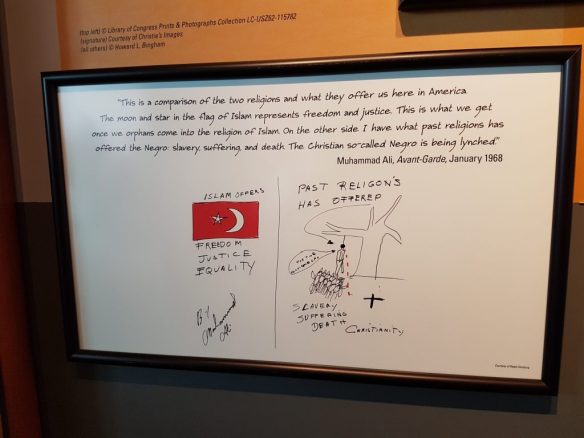
Ali said, “I chose to follow the Islamic path because I never saw so much love, so much people hugging each other…As a Christian in America I couldn’t go to the white churches.”

At the Muhammad Ali Center in Louisville, you will see this drawing by Ali, contrasting his experience of the difference between Islam and Christianity.  It speaks for itself:Ali-on-Christianity-1024x768
In the book, The Christ and the Indian Road, by E. Stanley Jones, the author tells about asking Gandhi how to naturalize Christianity into India.  Gandhi answered, “I would suggest first of all that all of you Christians, missionaries and all, begin to live more like Jesus Christ.”

I wonder if the story of Cassius Clay would have been different had Christians lived more like Jesus Christ. I wonder if I’m pushing anyone away from Christianity because I’m not living like Jesus.

I’ve heard it called the United States of Amnesia.  We must not forget how our past, present and future are woven together.

  • Let’s remember Muhammad Ali.
  • Let’s remember the culture in which he lived.
  • Let’s repent of any attitudes and actions that don’t reflect Jesus.

The Southern Baptist Convention (SBC) was founded in 1845 after Baptists in the North and the South clashed on the issue of slavery.  The SBC has been known for backing slavery then and in more recent history, racism.  In 1995 the SBC apologized for supporting racial injustice, for “condoning and or perpetuating individual and systemic racism in our lifetime, and we genuinely repent of racism of which we have been guilty, whether consciously or unconsciously.”

  • Let’s use our memories of the past to motivate us to create a better present and future.
 

If it Matters to God, it Should Matter to Us

What matters


On May, 1 the church I pastor replaced our regularly scheduled Sunday services with “acts of service,” performing service projects for organizations throughout our community.  It’s the second year we’ve done so.

At the “pre-service” kick-off that morning, I read portions of Isaiah 1:2,11-17:

Hear me you heavens! Listen, earth!

For the LORD has spoken:

“The multitude of your sacrifices – 

What are they to me?” says the LORD.

“I have more than enough of burnt offerings,

of rams, and the fat of fattened animals;

I have no pleasure in the blood of bulls and lambs and goats.

Stop bringing meaningless offering! 
Your incense is detestable to me…

Your New Moon feasts and your appointed festivals

I hate with all my being.

They have become a burden to me…

When you spread to your hands in prayer, I hide my eyes from you…

This was breaking news.

Universe-wide – “Heavens and earth.”

God tells us what matters to Him

Offerings? Nope.

Incense?  Detestable to Him.

Feasts and festivals? Hates them. A burden to Him.

Prayer? He doesn’t hear.

Sacrifices?  Surely He values the sacrifices!  That’s how they dealt with sin.  Sacrifices

served as the basis for the whole redemption system.

But look at these words:

“What are they to me?”

“I’ve had more than enough…”

“I have no pleasure in the blood of bulls and lambs and goats.”

Wait. What?  God doesn’t like blood sacrifices? This really is breaking news!

A quick cross-reference took me here:

“You do not delight in sacrifice, or I would bring it; you do not take pleasure in burnt offerings” (Psalm 51:16).

“Sacrifices and meal offerings You have not desired…Burnt offerings and sin offerings You have not required (Psalm 40:6).

“Does the LORD delight in burnt offerings and sacrifices as much as in obeying the LORD?  To obey is better than sacrifice, and to heed is better than the fat of rams” (1 Samuel 15:22).  

Sin offerings…

“No delight.”

“No pleasure.”

“Not desired.”

“Not required.”

It sounds like sin offerings and sacrifices for sin are not at the top of God’s list of priorities for us. Does that shock you?  It kind of does me.

So what is?


The answer is seen in what Isaiah continues to write:

“Learn to do right; seek justice.  Defend the oppressed.  Take up the cause of the fatherless; plead the case of the widow ” (Isaiah 1:17).

Here’s the answer through the prophet Hosea:

“For I desire mercy, not sacrifice, and acknowledgment of God rather than burnt offerings” (Hosea 6:6).  

Jesus picks up the theme in a rumble with the religious leaders and tells them, “Go and learn what this means: I desire mercy, not sacrifice” (Matthew 9:13).

Jesus repeats the idea in Matthew 12:7 when the Pharisees criticized him for letting his disciples pluck grain on the Sabbath.

Twice, Jesus tells us to go learn what it means when God says he desires mercy, not sacrifice.

Jesus is telling us to go back to school.  I wonder how many of us missed this lesson.  Why haven’t we taught the lesson?  Why have we mixed up God’s priorities?

One of my all-time favorite Christian songs was written and recorded by Steven Curtis Chapman, “The Walk.”

Chapman based his song on these words from Micah:

Will the LORD be pleased with thousands of rams, with ten thousand rivers of oil? Shall I offer my firstborn for my transgression, the fruit of my body for the sin of my soul?

He has shown you, O mortal, what is good. 

And what does the LORD require of you?
To act justly and to love mercy

and to walk humbly with your God.”

Is the title of this post true? “If it matters to God, it should matter to us.”

I told the people before we took to the streets that, to the best of my understanding, we were doing that day what mattered to God.

What do we learn?

What really matters to God?

The Debate, Genitals, the Bible

Rehoboam

Maybe I’m a prude.   Maybe I’m out of touch.

I never thought I was. But, maybe I am.

But, I just wasn’t prepared for a penis joke in a presidential debate.  I haven’t been prepared for a lot of things said in this presidential campaign.

As a pastor and Bible student, my mind immediately went to the Bible.
The Bible?  What does the Bible have to do with this?

Most of us agree that penises are out of bounds for a Presidential debate, but they aren’t out of bounds for the Bible.
You probably haven’t heard a sermon or Sunday School lesson on these stories but, they’re all in the Good Book.

Story 1:  In Exodus 4:24-25 we read about a woman named Zipporah who cut off a piece of her son’s foreskin and threw it at her husband, Moses.

I have a hard time getting over the first part of that passage, “…the LORD met him (Moses) at the lodging place and sought to put him to death.”  Whoa.  One moment God is calling Moses toward his destiny as Israel’s deliverer; the next moment God is trying to kill him because he neglected to “snip the tip”!  It’s stories like this that give God a bad rep.

The next part of the story is just weird when mom does the deed and throws the circumcised skin at Moses.

Story 2:  Every boy has doubled over after a below-the-belt injury.   Hope the damage isn’t too great!    If it is, you can’t enter the temple.  Here’s the verse: “If a man’s testicles are crushed or his penis is cut off, he may not be admitted to the assembly of the Lord” (Deuteronomy 23:1)- sorry John Bobbitt.

Story 3: The Song of Solomon, most realize, is a love poem, romantic and sexual.  Very sexual. Check out this verse: “…His abdomen is carved ivory inlaid with sapphires” (5:14).  Some translations say “His body is carved…”  “Abdomen” is closer to the Hebrew word.  But, she’s not saying her man has a six-pack stomach.  What she’s getting at is seen in the use of the word “carved ivory.”  She is calling to mind the original form of ivory – an elephant’s tusk.

Ivory – elephant’s tusk.

Yep.  You got it.  The lady in 5:14 is admiring her well-hung husband.

Story 4:  (See the photo at the top of post)  After King Solomon’s death, the kingdom of Israel split in two, Israel to the North, with Samaria as the capitol and Judah to the South, with Jerusalem as the capitol.  Solomon’s son, Rehoboam takes the throne, and pretty much all of Israel comes to ask him to go easier on them than his father did.  It was like, “You know, your dad treated us like slaves.  Can you, like, not do that so much?”  The wise older guys, who had been around the block, tell Rehoboam that he should have a “kinder and gentler” administration than his dad’s and he if does, he’ll win the hearts of his people.

But Rehoboam was having none of that wimpy stuff.  He was going to be tough. So, Rehoboam gets his frat bros together who advise him on the situation: “Here’s what you should say to the people who spoke to you , saying, ‘Your father made our yoke heavy, now you make it lighter for us!’  But you shall speak to them, ‘My little finger is thicker than my father’s loins!’ Whereas my father loaded you with a heavy yoke, I will add to your yoke; my father discipline you with whips, but I will discipline you with scorpions’” (1 Kings 12:10-11).

Some of you have rushed to your Bibles and found that your translation is much tamer, “My little finger shall be thicker than my father’s waist.”  Yes, that reading sounds much nicer when reading during a Sunday morning service.  But is it an accurate translation?  Not according to the experts:

Baker’s Bible Dictionary gives numbers and various ways the Hebrew word can be translated, then it says this:   “Loins can also refer to the genitalia (1 Kings 12:10).”

The message is clear, “My little finger is bigger than my dad’s penis, so you can just imagine what I’m packing.”  Rehoboam got into a measuring contest with his dad, the king who was famously able to satisfy a harem of 1000 women.

Sounds a bit like the recent “size of the hand” debate, doesn’t it?

Speaking of size, here’ the last of several genital stories in the Bible that I’ll  mention:

Story 5: The verse is Ezekiel 23:20“There she lusted after lovers, whose genitals were like those of donkeys and whose emission was like that of horses.”

We asked, “Why are Presidential candidates talking about “the size of hands?” Are you asking, “Why is the Bible talking about the genitals and emissions of barnyard animals?”

Ezekiel 23 is a long allegory about two sisters Ohola and Oholibah, representing Samaria and Jerusalem.  Both of these sisters grew up to be prostitutes.  Ohola was a prostitute for the Assyrians.  God was so angry with her that he had the Assyrians kill her and take away her children.

Oholibah sees her sister’s death but does not stop her prostitution.  In fact, she takes it one step further.  She goes to the Babylonians and has sex with them.  Disgusted by the Babylonians, she moves to the Egyptians.  She decides to stay with the Egyptians because their penises are like donkey penises and their semen is like horse semen.  Thanks for that image, Bible.

As uncomfortable as that image might make us, the rest of the story really disturbs me.

“Therefore, Oholibah, this is what the Sovereign LORD says: I will stir up your lovers against  you, those you turned away from in disgust, and I will bring them against you from every side…They will come against you with fury…I will hand you over to them for punishment so they can do with you as they please…They will cut off your nose and ears.  Your children will be taken and everything you own will be burned.  They will strip you of your clothes and jewels – slaughtering by the sword!  They will treat you with hatred and rob you of all you own, leaving you stark naked.  This is your fault and your shame will be exposed to all the world.  I will force you to drink from your sister’s cup of terror, filled to the brim with scorn and derision, distress and desolation.  You will drink it all and smash the cup to pieces, plucking off your breasts in anguish.  Yes, you will suffer the full penalty. Then you will know I am the LORD.”

Put yourself in the story.  Imagine the scene.  The blood-curdling screams as her ears were cut off without mercy.  The pain and shame as she was endlessly gang raped by her enemies.  Imagine being so desperate for your own death that you give in to the demands to rip off your own breasts with  your bare hands.  Imagine watching your own children being murdered with swords right in front of you.

Yes, this is an allegorical warning against turning away from God. But, I have to wonder if it is representative of how female prostitutes and adulterers were actually treated.

What are some take-aways from these stories, among many other stories, that are found in the Bible?

*Most “Bible-believing Christians” squirm at genital talk, so, isn’t it ironic that the Bible is actually filled with a lot of this kind of talk?

*Are we reading the Bible thoughtfully?  Are we reading it at all?  How could we have missed these stories?

*Maybe the Bible is more interesting than we thought!

*It makes me wonder, “Did God know that kids would be reading this?”  Should parents monitor their children’s Bible reading?  Should we think twice about “Bring Your Bible to School Day?” I’m kind of joking, but kind of not joking.

*Why do translators “sterilize” the text?

*Why do preachers and teachers do the same?

*How does the person and life of Jesus help us understand some difficult passages in the Bible?  How does the portrayal of God in Ezekiel 23 fit the portrayal of God in Luke 15?

Fatwa, the Bible, and Us

muslim-woman
 

Would you join a religion that permitted men to have sex with the women they captured in war? What if this religion codified this behavior in its holy book?


In a raid last spring on ISIS in Syria, a document was uncovered which outlines 15 points related to the keeping and raping of women captives.


The document, released to the public in the fall of 2015, had the authority of a “fatwa.” Do you have a question about a moral/religious issue? Is the teaching unclear? Call a religious expert who will give you a legal ruling – a “fatwa” – on the issue.


It’s Fatwa 64. You can read it here. A theology of rape.


Disturbing. Disgusting. Sickening. Shocking.


It is so repulsive I won’t put it in print.


Here’s my dilemma. There are in print, in another holy book, guidelines for the treatment of women captured in battle.


“When the LORD your God lets you capture the city, kill every man in it. You may however, take for yourselves the women, the children, the livestock, and everything else in the city. You may use everything that belongs to your enemies. The LORD has given it to you. That is how you are to deal with those cities that are far away from the land you will settle in. But when you capture cities in the land that the LORD your God is giving you, kill them all. Completely destroy all the people…” (Deuteronomy 20:10-16).


“When you go out to battle against your enemies, and the LORD your God delivers them into your hands and you take them away captive, and see among the captives a beautiful woman, and have a desire for her and would take her as a wife for yourself, then you shall bring her home to your house, and she shall shave her head and trim her nails. She shall also remove the clothes of her captivity and shall remain in your house and mourn her father and mother a full month; and after that you may go in to her and be her husband and she shall be your wife. It shall be, if you are not pleased with her then you shall let her go wherever she wishes; but you shall certainly not sell her for money, you shall not mistreat her, because you have humbled her” (Deuteronomy 21:10-14). I underlined “humbled” because the same Hebrew word is used in Judges 20:5 where it is translated “rape.”


“Now kill all the boys. And kill every woman who has slept with a man, but save for yourselves every girl who has never slept a man” (Numbers 31:17-18).


So Moses and Eleazar the priest did as the LORD commanded Moses. The plunder remaining from the spoils that the soldiers took was 675,000 sheep, 72,000 cattle, 61,000 donkey and 32,000 women who had never slept with a man” (Numbers 31:30-31, 35). Like the animals, the virgins are property to be divvied up.


In keeping with the guidelines set before them, it is recorded that the Israelites, to make up for a deficit of women in the Hebrew tribe of Benjamin,

“sent 12,000 fighting men with instructions to go to Jabesh Gilead and put to the sword those living there, including the women and children. ‘This is what you are to do,’ they said. ‘Kill every male and every woman who is not a virgin.’ They found among the people living in Jabesh Gilead 400 young women who had never slept with a man, and they took them to the camp at Shiloh in Canaan…So the Benjamites returned at that time and were given the women of Jabesh Gilead who had been spared. But there were not enough for all of them” (Judges 21:10-14).


Not enough women for all of them? What to do? What to do?


“So they instructed the Benjamites, saying, ‘Go and hide in the vineyards and watch. When the young women of Shiloh come out to join in the dancing, rush from the vineyards and each of you seize one of them to be your wife’” (Judges 21:20-21).


Well, at least this time, they only took the virgin girls without slaughtering everyone else.


Do you have the same dilemma as I?
We rightfully condemn Fatwa 64. So, what do we do with these guidelines and accounts found in the Christian’s holy book, the Bible?


Despite what some may think, I’m not trying to undermine the Bible or mess with anyone’s faith.


But, is it fair to think that anyone who is a serious student of Scripture has to face these passages and the issues they raise head on?


Isn’t it our Christian responsibility to take this on and not avoid it.


Since the Constitution demands that “no religious test ever be required as qualification to any office or public trust…” I’m not going to give a test. But I did learn a couple of lessons from a test given to Trump.


Candidate Trump was asked what his favorite Bible verse was after he said it was his favorite book.


“Well, I wouldn’t want to get into it, because to me that’s very personal. You know, when I talk about the Bible, it’s very personal, so I don’t want to get into verses.”


“There’s no verse that means a lot to you?” the questioner asked.


“The Bible means a lot to me, but I don’t want to get into specifics,” Trump answered.


Another question: “Are you an Old Testament or a New Testament guy?”

“Probably equal,” Trump said. “I think it’s just an incredible, the whole Bible is an incredible-“ Trump then trailed off for a brief second before joking that the Bible is his favorite book while his book, “The Art of the Deal” comes in second.


But, we do need to get into “specifics.”

We need to carefully, diligently analyze the Bible – both Old and New Testaments – to understand and determine how we’d answer the question: “Are you an Old Testament or a New Testament guy?”


There is disagreement, obviously, on how this issue should be handled. But maybe we can all agree on this: “…whoever claims to belong to him, must live as Jesus did” (1 John 2:6).


Seeing God in SNL

snl

It’s a rule of thumb that two topics should not be talked about over Holiday dinners with the family – politics and religion. But, honestly, the topics are hard to resist. They seem to pull us in. So we go there. And what starts out as a friendly gathering ends in a food fight.

Differences. Divisions over:


Climate Change.

The nationality of the President.

Presidential elections.

Syrian refugees.

Black Lives Matter.

Protests on University campuses.

The Confederate Flag.

The Bible and Gays.

Should LSU fire Les Miles (They did not)?


Did any of these come up at your family gathering?


All of these differences! But there is one thing that can bring us all together: Adele. SNL, in a sketch called “The Thanksgiving Miracle,” showed a politically polarized family who is able to find unity around the table thanks to the magic of “Hello” by Adele – who was the show’s musical guest. Check it out here.


Division is not limited to culture. We’ll find division in the church too. Relevant Magazine, in an article on church differences, says this: “Since Christ’s time on this planet, His followers have been arguing about almost everything. We argue about ‘essentials’ and ‘non-essentials’ and even who decides which is which.”


Division and disagreements in church?! Yep. Divisions over Scripture?  Yep.


Dr. D.A. Carson, one of the most well-known conservative theologians notes that “I speak to those with a high view of Scripture: it is very distressing to contemplate how many differences there are among us as to what Scripture actually says…The fact remains that among those who believe the canonical sixty-books are nothing less than the Word of God written there is a disturbing array of mutually incompatible theological opinions.”

Did you catch that?  “…how many differences there are among us…””…a disturbing array of mutually incompatible theological opinions.”


Who’s our Adele? Who or what brings unity out of division? Around what or who do we rally? Who or what is our glue?


The Bible says God is light (1 John 1:4) and God is love (1 John 4:8). Light and Love aren’t just what God does.   Light and Love are who God is.


Science tells us that almost every element on earth was formed at the heart of a star. Carl Sagan said in the TV series Cosmos, we are all made of “star stuff.” We were made by light and when you get right down to it light is what we are. This is because everything in the universe is made up of atoms, which themselves are made of protons, neutrons, and electrons. A proton is a positive electrical charge (or “light energy”). An electron is a negative electric charge. A neutron is neutral.


God is light. We are light. John puts it like this, “In Him was life, and the life was the Light of men” (John 1:4). He goes on, “There it was, the true Light coming into the world that illumines every person” (John 1:9).”You are the light of the world” (John 8:12; Matthew 5:14).


God is love. I like love. Who doesn’t?
The Beatles know it: “All you need is love.”

John Lennon knows it: “Love is the answer and you know that for sure.”

Even the Captain and Tennille know it: “Love will keep us together.”


Light and Love keep us together.

There is a connection – Light.

There is an expression – Love.


Galatians 5:6 says that the “only thing that matters is faith working through love.”

The only thing.  The. Only. Thing.

That is how positive energy (light) enters the universe.  Jesus did this to the max.  He was the Light and He used every bit of His energy to demonstrate Love.

Love and Light are our Adele.  They  unite us.  They supersede our differences.

Instead of arguing over this and that, what if we actually did the only thing that matters: love.

“Light” helps me to know I am connected to people – even the ones with whom I disagree. Light is my connection.

“Love” helps me to know how to relate to people – even the ones with whom I disagree.  Love is to be my expression.

“Thank you Adele.  Thank you SNL. Thank you God.”

“Christians Only?”


christians only 2.jpg

We are all trying to figure out the best path to peace out of the terror that is in our world today. One path chosen by some Presidential candidates is to make sure that the only refugees allowed to take a path into the U.S. are Christian. To steal a line from SNL, “Isn’t that special?”

The basis for the “Christian only” policy?

In one candidate’s own words: “There is no meaningful risk of Christians committing acts of terror.”

Let’s stay away from the political and go with the theological. I’ve got to ask:

First, How do we screen the refugees to ensure that Jesus is just all right with them? How do we prove someone is or isn’t a Christian? Is it a baptismal certificate? A fish bumper sticker? A date of when they walked the aisle, written in the front page of their Bible? A secret handshake? Do we go back to Biblical times and follow the pattern of identity given by God to Jewish men? Yikes.

Second, What if some non-Christian just pretended to be Christian in order to sneak into America?

Third, No Christian terrorists? “There is no meaningful risk of Christians committing acts of terror.” Really? Maybe this is about history as well as theology.
History has in it plenty of episodes of “Christians committing acts of terror”: 700 years of “Inquisition.”

The politician goes on to say, “If there were a group of radical Christians pledging to murder anyone who had a different religious view than they, we would have a different national security situation.” We could ask the Waldensians about what happens when you have a “different religious view” than the established church. We could ask the people of Oklahoma City and Charleston about the reality of Christian terrorism.

Then there is this page from history expressed on the pages of Jews, God, and History by Max I. Dimont, “New industries develop special skills, and the Nazi concentration camp industry was no exception. Adept Sonderkommandos learned to apply grappling hooks with skill to separate bodies. Trained technicians learned to pry dead lips apart and deftly knock out gold-filled teeth. Talented barbers dexterously shaved the heads of dead women. Six days a week, the new elite worked in the concentration camps. On Sunday, they rested, went to church with their wives and children, and after church talked with horror about the eastern front where Russians were killing German soldiers, and commented on the barbarity of the Americans, who were dropping bombs on civilians.

 History has shown that followers of Jesus have not always acted like Jesus.

Another candidate, proposing the “Christians only” view, was asked by a reporter about how he would determine who is a Christian. Here’s his answer “I mean, you can prove you’re a Christian.   I think you can prove it. If you can’t prove it, you are on the side of caution.”

 “How do you know if someone is a Christian?” is a legitimate question. Here’s Jesus’ answer:

“By this everyone will know that you are my disciples, if you have love for one another” (John 13:35).

“We know that we have passed from death to life because we love each other”
(1 John 3:14).

Just in case some interpret “each other” and “one another” only to apply to “other” Christians, there’s this zinger:

“You have heard the law that says, ‘Love your neighbor and hate your enemy. But I say, love your enemies! Pray for those who persecute you! In that way, you will be acting as true children of your Father in heaven” (Matthew 5:43-45).

As usual, I have more questions than answers:

If love is the proof of following Christ, then how many of us would be allowed in?

Should refugees pass a test before being allowed in? My limited understanding of the process in place leads me to believe that there is some kind of test.

Is Leith Anderson, president of the National Association of Evangelicals onto something when he says, “Of course we want to keep terrorists out of our country, but let’s not punish the victims of ISIS for the sins of ISIS.”

Does proposing a “Christian only” test show a misunderstanding of both Christianity and Islam?

How do we express the life and ways of Jesus in our world?  A member of a small group I attend is posing this question for discussion at our group’s gathering tonight: “What would Jesus do with a murderous Parisian terrorist?”

Your answer?


Christmas on a Cup?

starbucks-red-cup-christian-protest

In the ongoing “War on Christmas” the secularists have fired the first caffeinated shot against the Baby Jesus. Have you heard? Starbucks hates Christmas. The coffee giant has unveiled its new holiday cup seen above.

It’s solid red.

No Christmas designs.

No stars, reindeer, snowflakes or ornaments.

No manger scene.

Just a plain red cup.


So clearly, they hate Christmas – and they hate Jesus.


So says, Joshua Feuerstein in a Facebook post that has been viewed over 11 million times. His exact words, “Starbucks REMOVED CHRISTMAS from their cups because they hate Jesus…SO I PRANKED THEM…and they HATE IT!!!


He’s not alone. Raheem Kassan on breitbart.com says that those of us who indulge in a delicious drink from Starbucks out of a plain red cup are being “told/reminded that this time of the year is no longer about Christmas.” It’s almost like he could see me rolling my eyes because he ends his column with, “And no, ‘I’m not reading too much into it’. This is happening. And it’s as disgusting as an Eggnog Latte.” Well, he doesn’t need to drag eggnog into it.


Are Mr. Kassan, Rev. Feurestein and those who agree with them “reading too much into it”? I think so. Here’s why:


-I think this is one more sign that some Christians in the USA have a persecution complex.   One Presidential candidate said “We are moving rapidly toward the criminalization of Christianity.” Really? Is there any movement to prevent us from worshipping Jesus? From following Him? From living like Him? From loving our enemies? From blessing those who insult us? Paul writes that the fruit of the Spirit, the evidence of living a Christian life  is “Love, joy, peace, patience, kindness, goodness, faithfulness, gentleness, and self-control.”  Then he ends with, “There is no law against these things.”  No chance of these attitudes and actions being criminalized.


I remember being taught in Youth Group to expect “persecution” for following Christ. I wonder if Christian culture has caused us to look at anything that doesn’t fit into our particular religious/moral/cultural box and see anti-Christian discrimination.


-Is Christmas really defined by what is written or not written on a cup? Isn’t it a better celebration of Christ’s birth and a better recognition of Christ to actually live like Him?


“Those who claim to belong to him must live just as Jesus did” (1 John 2:6).


Isn’t it better to listen to and live out the angelic announcement of “peace on earth – good will toward men?”

Putting a Christmas message on a cup doesn’t compare to living out the Christmas message.


So, buy yourself a coffee in a plain red cup.

Buy one for the person behind you.

Buy one for the person at the intersection holding a “Homeless” sign.

Do something “good” for others.

“Do We Ever Understand it Wrong?”

Confederate Plaque

The Confederacy has been on my mind the last couple of weeks. I have connections with the South as does my wife. I went to high school in Little Rock where my parents still live. The name of the high school in Tyler, Texas from which my wife graduated was “Robert E. Lee,” no less.

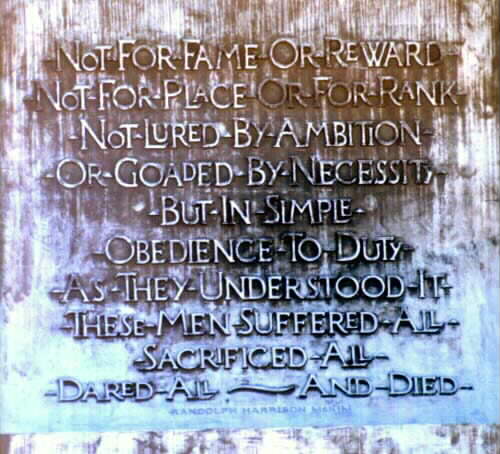
In my reading, I discovered the plaque, pictured above, located on the Confederate monument in Arlington National Cemetery.

I am struck by the line: “in simple obedience to duty as they understood it…“.

“…as they understood it…” That’s an interesting phrase.

I’m not sure of the intent of the author who wrote it, but is he leaving open the possibility that “they understood it” wrong?

It wouldn’t be the first time.

History is filled with examples of “understanding it” wrong.

“We pronounce, judge, and declare, that you, the said Galileo… have rendered yourself vehemently suspected by this Holy Office of heresy, that is, of having believed and held the doctrine (which is false and contrary to the Holy and Divine Scriptures) that the sun is the center of the world, and that it does not move from east to west, and that the earth does move, and is not the center of the world.”        June 22, 1633, the Church handing down its judgment against Galileo

“The earth is set firmly in place and cannot be moved. Who will dare to place the authority of this man Copernicus above the Holy Scriptures?”      John Calvin

“…sometimes the Scripture declareth women and children must perish with their parents…We had sufficient light from the Word of God for our proceedings.”    Capt. John Underhill, 1637, after leading a raid in which more than 400 Pequot women and children were surrounded and deliberately “broiled to death” or shot while trying to escape their burning encampment

“…if any man after legal conviction shall have or worship any other God, but the Lord God, he shall be put to death.”      1641, The Massachusetts “Body of Liberties” (Exodus 22:20; Deuteronomy 13:6-16, 17:2-7)

“The right of holding slaves is clearly established by the Holy Scriptures, both by precept and example.”     Rev. Richard Furman, first President of the South Carolina State Baptist Convention, 1823

“Slavery was established by decree of Almighty God…It is sanctioned in the Bible, in both Testaments, from Genesis to Revelation….”     Jefferson Davis, President of the Confederate States of America

“Wherever we have the races mixed up in large numbers, we have trouble…These religious liberals are the worst infidels in many ways in the country; and some of them are filling pulpits down South. They do not believe the Bible any longer; so it does not do any good to quote it to them. They have gone over to modernism…But every good, substantial, Bible-believing, intelligent orthodox Christian can read what the Word of God and know that what is happening now is not of God.”       Bob Jones Sr, in a sermon against integration entitle, “Is Segregation Scriptural?”, April 17, 1960

“The Bible clearly teaches, starting in the tenth chapter of Genesis and going all the way through, that God has put differences among people on the earth to keep the earth divided.”          1980, Bob Jones III, defending Bob Jones University’s policy banning interracial dating/marriage.

“As a citizen of the US, I have a right to vote. However, I do not exercise this right, because I believe that based on the Bible, it is wrong for women to vote.”   http://stevenandersonfamily.blogspot.com/2010/11/why-i-dont-vote.html

Observations:

Each belief and action stated above was based on what was read in Scripture.

These folks were dead certain that they stood on solid Biblical ground (Mark Noll writes in The Civil War as a Theological Crisis that “the Bible was the prime authority to defend the legitimacy of slavery.”).

Questions:

Are they just guilty of misunderstanding?

What do these examples say about the “The Bible says it, that settles it!” approach to Christian living?

How can people who were so sure of the Biblical justification for their beliefs and behaviors now be seen to be so wrong?

Application:

Maybe I need to hold my own interpretation of Scripture lightly.

Maybe I need to interpret Scripture more in light of the person of Jesus than anything else.

“Fear Will Be Your Ememy”

images

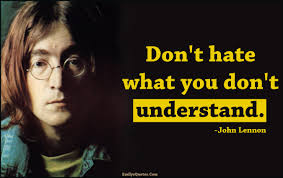
We tend to do that. To hate what we don’t understand.

It starts with fear.

We fear what we don’t understand. So…

We criticize it.

Or we dismiss it.

Sometimes, we smash it.

We see it in history:

After the last Amtrak accident, people may be a bit skittish about riding a train, but it’s nothing compared to how people felt in the 1820s with the invention of the steam locomotive. Anti-train propaganda warned that the human body would disintegrate under the stress of traveling at the unfathomable speed of 20mph. It was feared that men would asphyxiate, and women would suffer a more violent death due to their more fragile assembly.   Stay away!

We see it literature:

In Harper Lee’s “To Kill a Mockingbird”, Jem, Scout, and Dill don’t know Arthur Radley (Boo). They only know what people say about him. They believe what they hear and in their minds, they make it reality.  A scary reality.

“Inside the house lived a malevolent phantom. People said he existed, but Jem and I had never seen him.” Page 10

“People said he went out at night when the moon was down, and peeped in windows.” Page 10

“Boo was about six-and-a –half feet tall, judging from his tracks, he dined on raw squirrels and any cats he could catch, that’s why his hands were blood stained.” Page 16

By the end of the story, Boo is no longer a man to fear, but a man who is a friend.

We see it in TV:

Rod Serling’s “Twilight Zone” aired “The Gift” April 27, 1962. In the story, a space alien, who calls himself Williams, crash lands his rocket in Mexico. He has come to earth to give humanity the formula for a cancer-curing vaccine. He should be getting the red carpet! Right?

But before presenting his gift, he’s killed by some local soldiers. Led by fear and hate, they not only kill the visitor but also burn the document that contains the cancer curing formula.

The closing line from the episode: “We’ve not just killed a man. We killed a dream.”

Rod Serling, in that bewitching voice, offers this epilogue:

“The subject: fear. The cure: a little more faith.”

What is the cure for our fear of the unknown?

For Rod Serling, the cure is faith.

For Marie Curie, the first woman to win a Nobel Prize and the only woman to win the award in two different fields (physics and chemistry), the cure is understanding: “Nothing in life is to be feared, it is only to be understood. Now is the time to understand more, so that we may fear less.”

For Roman historian, Livy, the cure is knowledge: “We fear things in proportion to our ignorance of them.”

From John the Apostle, not the Beatle, the cure is love: “There is no fear in love. But perfect love drives out fear for fear, because fear has to do with punishment.”

The chief troll had it right when he told Elsa, in the movie “Frozen”, “Fear will be your enemy.” The fear that froze Elsa and everyone around her was thawed by the sacrificial love of her sister, Anna.

Do you think the sacrificial love of Jesus will do the same for our fears and us?

The Church as a Bar

churc it's a bar

I’ve been thinking a lot about beer and wine the last few days. The text for my teaching Sunday was John 2:1-11. You know, the “water to wine” story. So all week, I was studying with a Bible, commentaries, computer and a glass of Cabernet Sauvignon.

“Weddings and wine” reminds me of a letter Martin Luther wrote his wife in which he said, “I keep thinking what good wine and beer I have at home, as well as a beautiful wife…you would do well to send me over my whole cellar of wine and a bottle of thy beer.”

I keep thinking of the same things.

Martin Luther spent a lot of time at the Black Eagle Tavern where he spent many evenings after supper drinking rounds of bock beer and discussion heavy and light topics with his drinking pals.

For some reason, drinks and discussion go together.

Our church, The Venues, has followed Luther’s lead. One of our “venues” is a downtown bar on  Saturday night. On a weeknight, one of our men’s groups meets for study and discussion in a bar. Our Sunday venue is a normal church building but our values are bar-like.

Remember the theme-song from “Cheers”? Sometimes you want to go…

Where everybody knows your name. We want to be known.

And they’re always glad you came. We want to be wanted.

You wanna be where you can see, our troubles are all the same. We’re all struggling with something.

You wanna go where people know, people are all the same. All welcome. All valuable. All loved. All

We create space to listen to and learn from each other.

Christians don’t always listen well. We tell. But listen? Why should we listen when we have so much to say?

Christians don’t always learn well from others. We instruct others. Others learn from us. You have the questions, we have the answers. You have the problems, we have the solutions.

But to be bar-like is to value others opinions, critiques, insights into life and spirituality.

It is to listen to others.

It is to learn from others.

The truth is I don’t have it all figured out. I don’t have it all together.  My understanding of God, of life is continually in process. In fact, I’m a work in process.

You don’t have to drink a beer to be bar-like. Some don’t like beer. Some shouldn’t drink beer.

So have a root-beer.

But let’s be bar-like.