Thanks Mr. Sessions and Ms. Huckabee Sanders for the Bible Quote

Jeff Sessions

“The Bible says…”  We’ve heard that phrase in Sunday School, youth groups, and sermons.

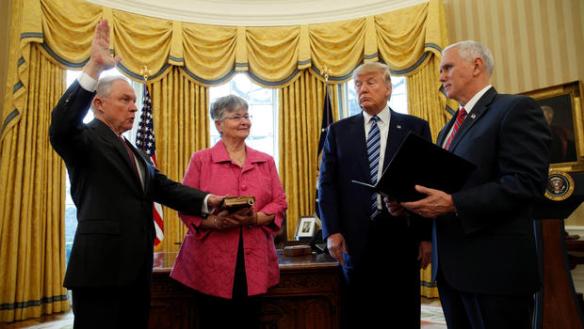
Now we’re hearing it in the White House Press Room from the Press Secretary, and in a speech from Attorney General Jeff Sessions.  

The issue to which the Bible was being applied was immigration,  specifically, the practice of separating children from their parents who have entered the United States illegally.  

Here are Mr. Session’s words, “Persons who violate the law of our nation are subject to prosecution.”  And then he brought Paul into it, “I would cite to you the Apostle Paul and his clear and wise command in Romans 13 to obey the laws of the government because God has ordained them for the purpose of order.  Orderly and lawful processes are good in themselves and protect the weak and lawful.” 

The Bible made another appearance in the press room when Sarah Huckabee Sanders was asked about the Attorney General’s use of the Bible.   She said, “I’m not aware of the attorney general’s comments or what he would be referencing.  I can say that it is very biblical to enforce the law…That is actually repeated a number of times throughout the Bible.”  

The purpose of this post is not to address the present immigration policy. I have an opinion.  You probably do as well. I want to think about how the Bible was used to justify the present policy.


Ours is not the first government to use Romans 13:1 to justify an action and to compel obedience to a law.  

*Loyalists to King George III and his government used Romans 13 to oppose the American Revolution.

*During the years leading up to the Civil War, defenders of slavery used Romans 13 against the Northern abolitionists.

*And then there’s Hitler.  Yep.  Hitler was a professing Christian, influenced greatly by Martin Luther’s anti-semitism.  He hated Jews but he loved Romans 13:1.  

Read carefully this quote from a Nazi book, “Life and Doctrine: Christian Teaching with Study Questions,” used by the Nazi regime:  

“What are those called in Romans 13:1 who God has set over us?  Have you considered that your parents, your school teachers (your principal), policemen, police chief, judges, the priest, the bishop, the county commission, the state government, are the authorities who are installed by God, and that you owe them obedience?…Over all, we owe the Fuhrer and the government obedience.  If you set yourself up against the authorities and against the state, you are standing against God’s structure and are subject to punishment.”  

 Hitler’s government used Romans 13:1 to squelch Christian resistance to his horrific policies.

Here’s the deal.  People on each side of the above issues could appeal to the same Bible as support for their particular positions.  And they have.  

Anyone wanting to enter a Bible debate with Sessions and Sanders could cite these verses:

Exodus 23:9 – “Do not oppress a foreigner; you yourselves know how it feels to be foreigners, because you were foreigners in Egypt.”

Matthew 25:44-46 – “They also will answer, ‘Lord, when did we see you hungry or thirsty or a stranger or needing clothes or sick or in prison, and did not help you?’ He will reply, ‘I tell you the truth, whatever you did not do for one of the least of these, you did not do for me.  They they will go away to eternal punishment but the righteous (just) to eternal life.”

Proverbs 14:31 – “He who oppresses the poor shows contempt for their Maker, but whoever is kind to the needy honors God.”

Isaiah 1:17 – “Seek justice, encourage the oppressed.  Defend the cause of the fatherless, plead the case of the widow.”

James 2:13 – “…judgment without mercy will be shown to anyone who has not been merciful.  Mercy triumphs over judgment.”

Mark 10:14 – “When Jesus saw this, he was indignant.  He said to them, ‘Let the little children come to me, and do not hinder them, for the kingdom of God belongs to such as these.’”  

One group has its verses.  The other group has its verses.  Same Bible.  Different views.  

What does this do to the understanding that the “Bible is Our Guide”?   

What kind of guide leads you in two different directions? 

Maybe the Bible itself has the answer!

I appreciate Mr. Sessions trying to base his decisions on an understanding of a higher truth.  But, if Mr. Sessions would have quoted Paul a little further, he would have said, 

“Let no debt remain outstanding, except the continuing debt to love one another, for whoever loves others has fulfilled the law. The law, ‘Don’t commit adultery, don’t covet, don’t steal, whatever other commands there may be, are summed up in this one command: ‘Love your neighbor as yourself.’ Love does no harm to a neighbor.  Therefore love is the fulfillment of the law’” (Romans 13:8-10).  

Paul just quoted the only Bible they had – the Old Testament – and then says, “It’s really about love.”  Is Paul saying, “Instead of getting hung up on different laws, just love.”   It’s not the only time Paul sings “Love is the theme.” 

“Make love your aim” (1 Corinthians 14:1).

“Do everything in love” (1 Corinthians 16:14).

“The goal of this command is love…” (1 Timothy 1:5).

And from a book my mom gave me to read in high school, Situational Ethics by Joseph Fletcher, 

“Only one thing is intrinsically good; namely love and nothing else at all.”

“Love and justice are the same, for justice is love distributed.”  

Should love be our ethic?

The right thing is the loving thing.  The loving thing is the right thing.  

What if all of asked before making a decision, setting a policy, saying a word, taking an action – “What is the loving thing?” 

I know I’d be a better person, husband, dad, pastor, and driver.
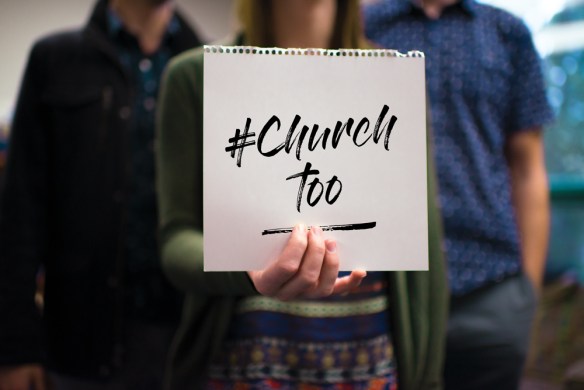
The Church, #metoo, #timesup and Me

ChurchToo-Photo_web


2017 was the year men learned that they can’t mess with women anymore. That’s a good thing.  Does anyone else remember the line from “Network:” “I’m mad as hell and I’m not going to take this anymore!”

That’s what we’ve heard from women assaulted by:

Harvey Weinstein

Larry Nassar

Bill Cosby

Travis Kalanick -Uber CEO

Bill O’Reilly

Roger Ailes

Matt Lauer

Charlie Rose

Louis C.K.

Bill Hybels

Roy Moore

Bill Clinton 

Donald Trump 

Now we can add Paige Patterson to the list.  For those who don’t follow news from the Southern Baptist Convention (SBC), check it out here and here. 

Dr. Patterson is a giant in the SBC.  He, along with Judge Paul Pressler, orchestrated the fundamentalist take-over of the SBC and has been a strong voice for fundamentalism in his position as a two-time President of the SBC, as President of two SBC seminaries, Southeastern Baptist Theological Seminary, in Wake Forest, NC, and Southwestern Baptist Theological Seminary (SWBTS), in Ft. Worth, Texas, the school from which he has been fired for his misogynistic views and statements.  

Dr. Patterson’s removal came only after women stood up and spoke out.  It started with Megan Lively, a former student at Southeastern Seminary who was told by Patterson not to report an alleged rape to police.   It was then discovered that Dr. Patterson advised an abused wife to return home and pray for her husband.  When she came back with two black eyes, he told her he was “happy” not because of her bruises but because her husband felt guilty after beating her and had accepted Christ. (I know so many pastors who have given similar advice to abused women. “Submit” to your husbands and all that…). The discovery of other incidents led the board of SWBTS to fire Dr. Patterson on May 30, 2018.

My interest in the story of Dr. Patterson stems from my roots in the SBC.  It was the denomination of my birth, childhood, and higher education.  I graduated from SWBTS under the Presidency of Dr. Russel Dilday, who was, ironically, fired by the very fundamentalist ideology represented by Dr. Patterson.  Dr. Dilday was fired for not being conservative enough. I first met Dr. Patterson when he was preaching a revival in the First Baptist Church of Batesville, Arkansas and the youth choir from First Baptist Church in Little Rock, of which I was a member, was singing.  Dr. Patterson was a good preacher.  I liked his sermon.  It kept my attention.  Very persuasive.  He could not, however, persuade the board to retain him.  

The #MeToo movement has reached the church.  

The word misogyny was coined by the Greeks because they needed to describe what was happening to women and girls in their culture.  We’re finally coming to grips with with what is happening to women and girls in our culture.  The realization did not occur because the men have stepped up, but because the women have come out – standing up, speaking out “We’re not going to take it anymore!”  

Here are a few things I’m pondering: 

Misogyny is not a problem in just one group.  We find it with conservatives and liberals.  We find it in Hollywood and in the church.  We find it with people who don’t read the Bible and with people who make studying the Bible their life’s work.  

As a Bible student and spiritual seeker, a Christ-follower,  I have to put it out there for us to consider:  

Is misogyny a direct, logical outgrowth of the patriarchy and sexism inherent in certain Biblical writings?  

Here’s what I’m talking about: 

The very first story.  Adam and Eve.  Adam is presented as the apex of creation.  Eve? An afterthought. Eve is pictured as morally weak, responsible for sin coming into the world.  Adam was even reprimanded by God for “listening to his wife.”   Then there’s the whole “he shall rule over you” statement to Eve.  Right out of the gate, the order is established:  Man is the ruler.  Woman is the subject.  

 Does this story reflect the heart of God or does it reflect the religious understanding of an ancient people?

Move on to the Ten Commandments which is, to many, the foundation of their ethical and moral lives.  Check out the “Covet” command.  Don’t covet the possessions of your neighbor – things like his house, his wife, his male or female servant, his ox or donkey, or anything else that belongs to your neighbor.  A wife is one more piece of property – listed between a man’s house and his servants.  

According to the law, recorded as given by God, if a woman is not a virgin at the time of marriage, she shall be stoned to death (Deuteronomy 22:20-21). The guy? No big deal.  It’s a double standard.  He doesn’t have to be a virgin at the time of marriage.   

Wanna New Testament example of misogyny?  1 Corinthians 11:7-9 tells us, in case we didn’t know, that a man is the image and glory of God, but not woman.   Woman is the glory of man. Sorry, women, I guess without us men, you’d never be able to reflect God.  

A particular reading and understanding of these and other passages can create a misogynistic view and treatment of women. Has it?  I think so.  

The Bible presents an ethic of progression…a trajectory.

The Bible does not always give us the last word on an issue.   Instead, it initiates a trajectory that leads to an ultimate ethic.  It’s true with slavery.  The Bible condones slavery – pure and simple.  Yet, we condemn it.  Why?  We recognize an ethic that goes beyond the Bible.   It is also true with women.  So, will we live out an ethic that men are superior to women or follow the trajectory of the Bible that leads to an ethic of absolute equality?

#timesup = “repent for the kingdom of heaven is here” (Matthew 4:17)

Change the way we think, the way we see.  The old paradigms are gone – “old wineskins are replaced with new ones” (Luke 5:36-39) There is a new way to live.  A new way to see people.  A new way to treat people.  The values of the kingdom – love, justice, kindness, humility, replace the values of control and dominance.  

Thank you women for standing up and speaking up.  We’re listening. 


Jerusalem: Politics, Peace or Prophecy

Jerusalem2

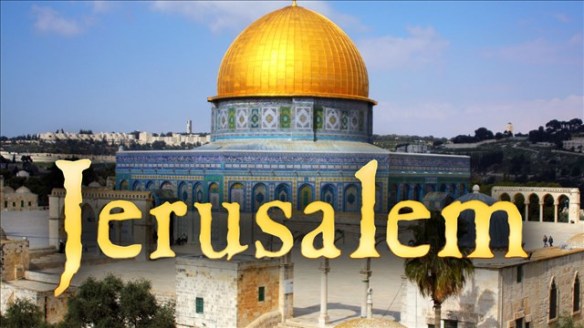
The US officially recognized Jerusalem as the capital of Israel, Monday, May 14, and opened there the US Embassy.

On hand were two preachers:  Robert Jeffress, pastor of First Baptist Church, Dallas, and John Hagee, pastor of Cornerstone Church in San Antonio, both asked by President Trump to offer prayers at the Embassy’s dedication.

The preachers were bookends to the event – Jeffress doing the invocation and Hagee the benediction.  

A political event?  A church event?  Which one was it?  

Confused?  The flash-back in my mind upon hearing the news may clear it up. It was a conference room at Forest Park Baptist Church in Joplin, MO.  Wednesday night – Church night. Youth Bible Study.  Our Youth Minister, as they were called then, was George Jones. 

The book we were studying?  The Late Great Planet Earth, by Hal Lindsey. The book had just been released (1970) and it was hot.  It remained hot, selling more copies in the 1970s than any other work of nonfiction in the United States.  It’s still in print.  

The youth group, of which I was a part, was really into it.   There’s nothing like end times, mayhem, judgment, escape, to grab your attention; to build a crowd; to get people “saved” as the only way to escape the coming Tribulation.  

We saw the “end times” in terms of 5 events: 

First, Jesus will “rapture” the church – His true followers (which was basically defined as members of our church and churches like it) will be “caught up” with Jesus and swooshed off somewhere to be with Jesus where, from that vantage point, we will watch the:

“Tribulation,” the second event.    The Great Tribulation is 7 years of global chaos where all those who were “Left Behind” because they did not accept Jesus as their personal Lord and Savior will go through unimaginable horror. The Tribulation ends with:

the third event: The Second Coming of Jesus.  At this event, Jesus bursts through the clouds on a white horse ready to give Satan, and everyone who didn’t become a Christian during the Tribulation, what’s coming to them in the epic Battle of Armageddon.  At the conclusion of the battle, Satan is put in chains, thrown into a bottomless pit for 1000 years, ushering in the 4th event:

The Millennium. With Satan locked up, and Jesus ruling from a Throne in Jerusalem, kids fly kites all day, lions play with lambs, Republicans hang out with Democrats, Cardinal fans sit next to Cub fans.    There is peace.  After the 1000 years of peace, God cuts Satan loose for one last hurrah to see who will follow him and who will follow God.  Finally, there is:

The Great White Throne Judgment.  “Here comes the Judge.”  After a big courtroom scene, Satan and all the non-Christians will be thrown into a lake of fire where they will be tormented night and day, forever, for eternity, no ending.  

That was the view we were taught.  That is the view many if not most Evangelical Christians still hold.  Not me…but that’s for another time.  What does the U.S. Embassy moving to Jerusalem and Jerusalem being recognized as Israel’s capital have anything to do with this view of the “end times”?  

Back to Hal Lindsey.  In Lindsey’s drama, Israel played the leading role.  He believed that as the world moved toward the end, three events would occur:

1.  Jews would retake Palestine. That happened 70 years ago this week – May 15, 1948.

2.  They would repossess old Jerusalem and its sacred sites.

3.  They would rebuild King Solomon’s temple on its original historical site, where the Dome of the Rock stands presently.  

The role of Israel in making the “end times” happen is expressed by John Hagee – the guy who said one of the prayers at the Embassy Dedication, “I believe at this point in time, Israel is God’s stopwatch for everything that happens to every nation, including America, from now until the Rapture of the Church and beyond.”  

The other pray-er, Jim Jeffress, said this about Jerusalem: “It is the place where Jesus, a Jew himself, was crucified and where he was resurrected, and the place where he will set foot again on earth at his second coming.”

The thinking is: the more established and recognized the government of Israel is and the more closely its borders resemble the borders of biblical Israel, the closer we get to the Rapture.  

The motivation of many Christians is not a desire to bring peace to a turbulent region, but a belief that moving the capital to Jerusalem will hasten the end of the world. 

It’s not about politics.  It’s not about peace.  It’s about prophecy.

Judge Jeanine, a commentator on Fox News, said on her broadcast last Saturday that by moving the Embassy to Jerusalem, President Trump “fulfilled Biblical prophecy.” 

At a rally on December 7, 2017, Florida State Senator Doug Broxson introduced President Trump to the crowd and spoke of the President’s recognition of Jerusalem as the capital of Israel as a win for people of faith, declaring,  

“Now I don’t know about you, but when I heard about Jerusalem – where the King of Kings, our soon coming King is coming back to Jerusalem, it is because President Trump declared Jerusalem to be capital of Israel.” 

How much influence did the “praying preachers” have on the decision of the United States government to move the embassy to Jerusalem? 

How much influence does a certain “end times” view have on the policy of the United States?  

What should be our concern?  Peace or Prophecy?

Where is God’s temple today?  It’s not on a rock.  Not in a building.  Not in a city.  It’s in us: Acts 7:48, Acts 17:24, 1 Corinthians 6:19, 1 Corinthians 3:16, Luke 17:21.

The two preachers are living out their beliefs.  I guess I need to be careful what I believe.

“God Helps Those Who Help Themselves” Part 3 of “Shoot Christians Say”

I-NEED-HELP-GUYS-meme-29959


“God helps those who help themselves.”

Most frequently, I hear the phrase from people in relation to the poor and/or homeless.  “Well, as the Bible says, ‘God helps those who help themselves.’”

Except it doesn’t say that.

Benjamin Franklin said it.  And others before and after him.  But Jesus didn’t.  No one in the Bible did either.

Paul did say something like it.  What he said is recorded in 2 Thessalonians 3:10: “If anyone is not willing to work, he should not eat.”  

In some people’s minds, the two phrases go hand in hand.  Paul’s words to the church in Thessalonica are even heard on Capitol Hill in debates on funding for the poor.  

I get amused by those debates.  People use the same Bible to support their completely contradictory views.  A person who wants to cut aid to the poor quotes the “don’t work don’t eat” text.

A person who doesn’t want to cut aid to the poor quotes verses like Leviticus 23:22.

Using the Bible can be so confusing!    

Back to Paul.  Obviously, Paul wasn’t writing to Americans.  He didn’t see a homeless person on the street and say, “If you don’t work you don’t eat.”  What he did see were church members not working because they thought Jesus was going to come back any minute.  “Why go to work when Jesus might come back?”  

I like N.T. Wright’s take on that:  “Jesus is coming- plant a tree!” 

Back to “God helps those who help themselves.”

Using this phrase to avoid helping the poor misses the whole point of Jesus and the Scripture.

Those who enact unjust polices are as good as dead, those who are always instituting unfair regulations, to keep the poor from getting fair treatment, and to deprive the oppressed among my people of justice (Isaiah 10:10-2).  Let’s put that on a plaque and hang it in the halls of Congress!

Don’t mistreat widows or orphans or foreigners or anyone who is poor…(Zechariah 7:10).

If you don’t help the poor, don’t expect to be heard when you cry out for help (Proverbs 21:13).

The Lord’s Spirit has come to me…to tell the good news to the poor…to free everyone who suffers (Luke 4:18).  

Suppose you see a brother or sister who has no food or clothing, and you say, “Good-bye and have a good day; stay warm and eat well” – but then you don’t give that person any food or clothing.  What good does that do (James 2:15-16)?

So, let’s forget about this phrase absolving us of our responsibility to help the poor. 

Let’s feed and clothe. 

Let’s challenge and change unfair legislation and structures.  

Let’s identify with the poor. 

What’s good about the phrase?

*It reminds us that God uses people to change the world.  We’re partners.  ‘Blessed are the peacemakers for they will be called children of God” (Matthew 5:9).  It’s a “God plus us” thing.  

*It reminds us that we do have some responsibility.   It doesn’t make any sense to ask God to help me not eat so many potato chips unless I quit buying potato chips.   

“There is an expiry date on blaming your parents for steering you in the wrong direction; the moment you are old enough to take the wheel, responsibility lies with you.”  J.K Rowling

Here’s my biggest problem with the phrase:  It seems to me to go against grace – you know,  “unmerited favor” – as I learned in Sunday School.  

God gives me love and acceptance when love and acceptance are undeserved.  

“While we were yet sinners, Christ died for us” Paul writes. 

I love this from Philip Yancey, “There’s nothing I can do to make God love me more.  There’s nothing I can do to make God love me less.”  

Now that’s something we should be saying!

“Shoot Christians Say, Part 2 -” “God Said It, I Believe It, That Settles It.”

holy shit 2

“The B-I-B-L-E.  Yes that’s the Book for me.

I stand alone on the Word of God.

The B-I-B-L-E”

That little song, learned and sung around snacks of Kool-Aid and Animal Crackers, flannel graph Bible stories in the Sunday School of my childhood, formed the foundation of my understanding of the Bible.  

It’s dangerous to mess with someone’s foundation. 
It’s uncomfortable.  Scary. Risky.

But that’s what I did with last Sunday’s phrase in our “Shoot Christians Say” series.  Here it is:  

“God Said It, I Believe It, That Settles It” 

The teaching, for some, was tantamount to messing with motherhood, the flag and apple-pie. 

A bit unsettling.  

Think it through with me:  “God said it, I believe it, that settles it.”  Except it doesn’t.   Settle it, that is.  If it settled it, why do we debate it?  If it settled it, how do we explain books like Zondervan Counterpoint Series – “indispensable for understanding different views on Christianity’s vital issues” (Zondervan’s description of the series)?  

If “that settles it” why are there “different views” not just on side issues, but on “vital issues?”  

We want to be settled.  We want to be sure.  Being settled is a basic need. The two largest Christian groups have addressed the need to be settled.

Protestants, the folks that protested the Catholic Church developed the infallibility of Scripture.  

Catholics developed the infallibility of the Pope.  

“Infallibility”- the inability to be wrong.

Both the Bible and the Pope speak for God – depending on if you are Catholic or Protestant.  

And what is spoken is infallible. That is settling. 

 Both positions come from a need for security, for something strong on which to stand.  These positions give us that, “I’m secure with ‘the Bible tells me so, ‘“ or “I’m secure with ‘the Pope tells me so.’”  Standing on this foundation, I don’t have to think, wrestle, or try to figure things out.  I just go with what is said.  

This position meets our need for security, but does it meet our need for truth?  Maybe not.

The Pope “said it” but got it wrong about the sun orbiting the earth.  Ask Galileo.  The church admitted it was wrong 359 years later.

The Bible “said it” but got it wrong about slavery.  

 “Slaves, obey your earthly masters with fear and trembling” (Ephesians 6:5).

 “Teach slaves to be subject to their masters in everything, to try to please them, not to talk back to them” (Titus 2:9).

“Slaves, in reverent fear of God submit yourselves to your masters, not only to those who are good and considerate,  but also to those who are harsh” (1 Peter 2:9). 

The Southern Baptist Convention, the denomination into which I was born, raised and educated, admitted in 1995 that it got it wrong, apologizing for its support for slavery and segregation.

The Bible did not “settle it” when it came to slavery.  In fact, what the Bible says about slavery is unsettling.  

Jesus did not operate on the basis of  the “God said it, that settles it…” position.

Do you remember all of those, “You’ve heard it said, but I say to you…” verses?
Compare and contrast the following:

Deuteronomy 6:13 and Matthew 5:33-37

Deuteronomy 19:21 and Matthew 5:38-39

Numbers 15:32-36 and John 5:8-10

If  it were “settled” why did Jesus challenge and change it?

The apostles didn’t stick “God said it, that settles it” on the rump of their horse or the bumper of their chariot.  Acts 15 tells us that the apostles debated how the Bible applied to their lives and situation.  When they set aside circumcision as a requirement for following Jesus they reinterpreted the Bible for their times, recognizing that some of what “God said” was not God’s will for all time, all places, all people.

Even those today who say the phrase, don’t practice the phrase.  How many of you give other church-goers a “holy kiss” each Sunday?   You don’t? Why not?  Paul commanded it 4 times in his letters.  Try it next Sunday and see how it goes. 
“God said it”  but with that command, and others, it’s not settled.  How many other things did “God say” aren’t settled?  “Welcome interpretation.  Come on in and let’s get to know each other better.”

This post is already too long, kind of like my teaching last Sunday – 35 minutes! So, I’ll cut to the chase ( a phrase used in the movie world by directors to get past the boring dialogue and to the excitement of a chase scene).

I don’t call the Bible the Word of God.  I call Jesus the Word of God.  So does John.  A “word” is an expression of an idea.  It is my understanding that Jesus is the “exact expression” of God. 

Not the Bible.  Check out Hebrews 1:1-3 and note the phrase “exact expression.”  Does that mean that the Bible (Hebrews 1:1) is inexact?

Maybe the problem is not the Bible.  Maybe the problem is how we use the Bible – what we expect out of the Bible.  Again, let’s take our cue from Jesus.  Seems to me like a good idea.

John 5:39. No one knew the Bible better than the Pharisees.  They knew it up and down, in and out, forward and backward.  Yet they missed God in the flesh who was standing right in front of them.  

Is it possible to be so busy following the Bible that we miss Jesus?  The Bible is a sign that points to Jesus – to his life, to his way, to his values.  

Why do we settle with the sign instead of going on to the destination?  

I’ve written too much.   If you’ve stayed with me, you’ve read too much.  Let’s both stop. 

Let’s spend some time looking at Jesus. Appreciating him. Following him and his way.  


What a Relief!

alka seltzer

Yesterday (Sunday November 9) was “National Chaos Never Dies Day” – where do they come up with this stuff – but I digress.

“Chaos,” according to the first entry of a Google search means: “disorder, disarray, confusion.”

So, if school is stressful, work is wacky, home is hectic, November 9 is your day.

A day to let it out, admit it, face it.

I’m teaching a series now in which we are facing, admitting the fact that one thing that causes us to experience chaos is – here it is – reading the Bible.

It takes a lot of guts just to admit that doesn’t it?   But it’s true. How could we not experience some chaos when we read this from Exodus 21:20-21

If a man beats his male or female slave with a club and the slave dies as a result, the owner must be punished.   But if the slave recovers within a day or two, then the owner shall not be punished, since the slave is his property.

Who can honestly read that and not think, “What the …?!

“Oh, that must just be a record of what some guy said…” Sorry.  According to the Bible, it wasn’t just a guy. It was God.

Chaos. Confusion.

Here’s another. We’re justifiably horrified and disgusted with the genocidal attitudes and actions that we see from extremist Islamist. Like these words from a member of Isis. God willing, this generation will fight infidels and apostates, the Americans and their allies, God willing. The right doctrine has been implanted in these children. All of them love to fight for the sake of building the Islamic State and for the sake of God.”

Yep, Isis wants to wipe us out – all in the name of God.   “For the sake of God” “God willing.” We instinctively know that’s wrong. We know such a view and vision does not accurately reflect God. But then we read this:

They (Joshua’s army) completely destroyed everything in it (Jericho) with their swords – men and women, young and old, cattle, sheep and donkeys. Joshua 6:21

“Well, that must have been Joshua acting as a rogue commander!” Then we see this:

So the Lord was with Joshua and his reputation spread throughout the land. Joshua 6:27

Hmmm.  So God was with Joshua through all of that?  Really?

According to Deuteronomy 20:16, Joshua was faithfully following the command given by God through Moses which said, “In those towns that the LORD your God is giving you as a special possession, destroy every living thing.”


Chaos. Confusion. If it’s wrong for Isis to do that now was it right for Joshua and the Israelites to do that then.

How do we clear up the confusion? How do we find some calm in the chaos?

I got some help from one of my seminary professors – Yes, I remember a few things from my education.  He said, “If you thought God told you to do something, you would do it. Now, the question is, ‘What is Jesus telling us?'”

He answered his own question by quoting Matthew 5:43-44, “You have heard the law that says, ‘Love your neighbors but hate your enemies, but I say,  Love your Enemies.”

Wow. RADICAL!   Is Jesus saying what it sounds like he’s saying?  Is he re-framing or even overturning Scripture?  Things like that can put you on a cross.

Hermeneutical principle here?

Jesus takes precedence over Moses and according to Hebrews 1:1-3, every other “revelation”: Long ago God spoke many times and in many ways to our ancestors through the prophets. Now in the final days, he has spoken to us through his Son…The Son radiates God’s own glory and expresses the very character of God.


That is like a dose of Alka-Seltzer: “Plop. Plop. Fizz. Fizz. Oh what a relief it is.”

I feel immediate relief – Jesus is the hermeneutical lens through which we interpret Scripture. He is the standard by which every other word is measured. We’ll unpack that a bit more in the days to come.

Free From the Law, O Happy Condition

Image

I’ve heard some questions, and some protests, about my position that Christians are not under the law:

“If we don’t have to obey the law of Moses, what’s to keep us from sinning?”
“Isn’t anything sin anymore?”

Behind these questions lies a fear that the grace message is an invitation to sin.  We’ve seen that fear before:

“What shall we say, then? Shall we go on sinning so that grace may increase?” (Romans 6:1),  the Roman Christians ask in response to Paul’s grace message in Romans 5.

Paul’s answer?  “By no means! We are those who have died to sin; how can we live in it any longer?” (Romans 6:2).

Then, Paul speaks to the Law issue, “For sin shall no longer be your master, because you are not under the law, but under grace.  What then? Shall we sin because we are not under the law but under grace? By no means!” (Romans 6:14-15)

Two things seem real clear:
We are not “under the law.”  I really don’t know how we miss that.  How can Paul be more plain?
Being out from under the law does not give us a license to sin.

I’ve got a couple of questions of my own:

Why does a Christ-follower choose to live by the Law instead of the Spirit? I don’t get people who don’t like chocolate and I don’t get Christians who live by the Law.

“Law following” Christians claim to want to live like Jesus.   I believe they really do. But following the Law won‘t get us there.
“through Christ Jesus the law of the Spirit gives life has set you free from the law of sin and death.” (Romans 8:2) – The law brings death, not life.

“So, my brothers and sisters, you also died to the law through the body of Christ, that you might belong to another, to him who was raised from the dead, in order that we might bear fruit for God.” (Romans 7:4)  There’s no fruit on the Law-tree.

“You who are trying to be justified by the law have been alienated from Christ; you have fallen away from grace.  For through the Spirit we eagerly await by faith the righteousness for which we hope.” Galatians 5:4-5)  If we choose to live a “righteous” life by following the Law then we cut ourselves off from the resources provided by God – His grace. Paul gives us a choice: Grace or Law?  We can’t have it both ways.

Paul asks my next question. It’s a tough one:  “O,  foolish Galatians! Who has cast an evil spell on you?  For the meaning of Jesus Christ’s death was made as clear to you as if you had seen a picture of his death on the cross.  Let me ask you this one question: Did you receive the Holy Spirit by obeying the law of Moses? Of course not! You received the Spirit because you believed the message you heard about Christ.  How foolish can you be? After starting your Christian lives in the Spirit, why are you now trying to become perfect by your own human effort?  Have you experienced so much for nothing? Surely it was not in vain was it?” (Galatians 5:1-4

Paul doesn’t hold back.  He doesn’t sound happy.  He uses some harsh language: “Foolish” literally – a “non-thinker.”  “Cast an evil spell” -under the spell of false teachers.   He sounds frustrated and angry that people are buying what the Judaizers are selling – the teaching that Christ-followers have to follow the Law.  Maybe he’s mad at the sellers as well.  He calls them “dogs” in Philippians 3:2.

“Let’s think this through, “ Paul seems to say.  “If we aren’t saved by obeying the Law then we don’t live the Christian life by obeying the Law.”  There’s a new sheriff in town.  His name is the Holy Spirit and His law is love.

“If you really keep the royal law found in Scripture, ‘Love your neighbor as yourself,’ you are doing right.” James 2:8

“…for whoever loves others has fulfilled the law.” Romans 13:8

“Love does no harm to a neighbor. Therefore love is the fulfillment of the law.” Romans 13:10

“For the entire law is fulfilled in keeping this one command: “Love your neighbor as yourself.” Galatians 5:14

“I am astonished that you are so quickly deserting the one who called you to live in the grace of Christ and are turning to a different gospel…” Galatians 1:6

“…because through Christ Jesus the law of the Spirit who gives life has set you free from the law of sin and death.”  Romans 8:2

Back in my childhood in every Baptist church to which I belonged, we sang songs by Philip P. Bliss: “Wonderful Words of Life”  “Jesus Loves Even Me” and this one:

Free from the law, O happy condition
Jesus has bled and there is remission,
Cursed by the law and bruised by the fall,
Grace hath redeemed us once for all.

Now we are free, there’s no condemnation,
Jesus provides a perfect salvation.
“Come unto Me,” O hear His sweet call,
Come, and He saves us once for all.

Paul got it.  Philip Bliss got it.  I want to live the rest of my life getting it.

Jesus Fought the Law and the Law Lost

Image

Headlines like the one above really irritate some people.  “How dare they pick and choose?!”  But be honest.  We all pick and choose.  Who among us obey all 613 commands of the Mosaic law?  That’s right.  Some people believe that the Law is just the Ten Commandments.  Actually, the Law of Moses contains 613 commandments covering everything from blood sacrifices to men’s haircuts to sewage disposal to charging interest on loans.

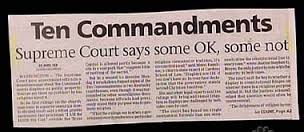
The New Testament seems to take a few steps further than the Supreme Court:

Romans 6:14: For sin shall no longer be your master, because you are not under the law, but under grace.

Romans 7:4: So, my brothers and sisters, you also died to the law through the body of Christ, that you might belong to another, to him who was raised from the dead, in order that we might bear fruit for God.  

Galatians 2:19: For through the law I died to the law so that I might live for God.

Romans 7:6: But now, by dying to what once bound us, we have been released from the law so that we serve in the new way of the Spirit, and not in the old way of the written code.

Galatians 3:24-45: So the law was our guardian until Christ came that we might be justified by faith.  Now that this faith has come, we are no longer under a guardian

Colossians 2:14: ...having canceled the charge of our legal indebtedness, which stood against us and condemned us; he has taken it away, nailing it to the cross.

Hebrews 8:13: By calling this covenant “new,” he has made the first one obsolete; and what is obsolete and outdated will soon disappear.

Hebrews 10:9:  He sets aside the first to establish the second.

Romans 10:4:  For Christ is the end of the law for righteousness to everyone who believes.

Ephesians 2:14-15:  For he himself is our peace, who has made us both one and has broken down in his flesh the dividing wall of hostility by abolishing the law of commandments expressed in ordinances…

Not under law; died to the law; dying to what once bound us;  released from the law; no longer under a guardian; nailed to the cross; obsolete; set aside; Christ is the end of the law; abolishing the law.  Strong words.  Clear communication.

I can hear the objections: “But wait!  What about Matthew 5:17-19? Take that!  See, the law is still in effect.  We’re still supposed to follow it.”  Jesus said,  Do not think that I have come to abolish the Law or the Prophets; I have not come to abolish them but to fulfill them. For truly I tell you, until heaven and earth disappear, not the smallest letter, not the least stroke of a pen, will by any means disappear from the Law until everything is accomplished…”

Well, this is confusing.  Paul says Jesus abolished the law (Ephesians 2:15) and Jesus says he has not come to abolish the law!  What’s up?

Back it up.  Jesus did say the law would disappear when two things happened: 1. heaven and earth will disappear,  and, 2. everything is accomplished.   When those two things happen, the law is out of here! It’s gone. So long.  See ya later.  Gone like Roger Daltrey’s shirt.

#2 – Everything is accomplished –  At a key moment Jesus announced that everything was finished – at that moment. “It is finished.” John 19:30

#1 – Heaven and earth will disappear – Well, that obviously means a literal heaven and earth disappearing. Doesn’t it?  Maybe not.
If “heaven and earth” refers to a literal, physical heaven and earth, then, yep, the Law of Moses has not passed – it’s still alive and kicking.  But I believe that “heaven and earth” is a metaphor for political or national systems.  Take a look at these references:
Isaiah 1:1-2; Isaiah 24:3-6; Isaiah 34:3-5; Hebrews 12:26-28; Matthew 24:29; Luke 21:32-33

In the last two references Jesus wasn’t speaking of a physical heaven and earth but of a system – a way of doing things – the Mosaic Covenant with its laws, sacrifices, priesthood, tabernacle (Hebrews  9:8-11).  Jesus was speaking of the fall of Jerusalem that would happen about 40 years later in A.D. 70 when God removed the things that could be shaken and in their place gave His people a Kingdom which can never be moved (Hebrews 12:18-28).

Luke 21:32-33 contains the same elements as Matthew 5:17-19 – the disappearance of heaven and earth and everything accomplished.

Jesus and Paul are not in conflict with one another.  Heaven and earth – the system under the Mosaic covenant disappeared bringing on the abolishment of the law!!!!

So, I guess we can just let ourselves go wild?!  God, as always, has this covered;
So Christ has truly set us free.  Now make sure you stay free, and don’t get tied up again in slavery to the law…For you have been called to live in freedom … but don’t use your freedom to satisfy your flesh.  Instead, use your freedom to serve one another in love…So I say, let the Holy Spirit guide our lives.  Then you won’t be doing what your flesh craves (Galatians 5:1-16).

The law or the Holy Spirit?  What is our choice?

What About the Law?

Image

Over the last few weeks I have followed the discussion in the blogosphere concerning the role of the Old Testament law.  The question centers on a variation of Moses’ statement made in the above “Speed Bump” cartoon: “What part of the law is meant for us?”

People answer that question in one of three ways:
1. All of it.  2. Some of it.  3. None of it.

Let’s look a bit more closely at the three options:

1. Think hard about this before you say, “Of course all of it is meant for us! God said it so I’ll do it!”  Placing yourself in that group means that you’ve cleaned all of the cotton-polyester     clothes out of your closet – Leviticus 19:19; Deuteronomy 22:11; that you order your     steak “well-done,”  Leviticus 19:26; that you never cut your hair, Leviticus 19:27 (If only I would have used that verse during the great hair-debates of the 60s); and other behaviors that just don’t make much sense to us today.

2. The “some of it” group is huge.  This view breaks the law into three categories:
a. The moral law – declares how man should live.
b. The civil law – describes the legal structures for the ancient nation of Israel.
c. The ceremonial law – declares how Israel was to worship.

The “some of it” group says that only the moral law is “meant for us.”  The ceremonial     and civil laws were meant only for ancient Israel.   So, “Don’t murder” still applies but not the “no haircut” rule. This view is the one held by most Christians today.

3.   The “none of it” answer is the one that I believe is the right one.  To explain why will take a lot longer than one post! Let’s jump in.

*The Bible gives no hint of different “kinds” of law.  It’s all one.  Joshua speaks of the Law as one unit when he writes in Joshua 1:8, “Keep this Book of the Law always on your lips; mediate on it day and night, so that you may be careful to do everything written in it.  Then you will be prosperous and successful.”

It sounds like Paul does the same thing in Galatians 5:3, “Again I declare to every man who lets himself be circumcised that he is obligated to obey the whole law.”

No division by either Joshua or Paul.

*How do you pick and choose?  It gets confusing.  “Love your neighbor as yourself” (Leviticus 19:18) is followed in the very next verse by the law “do not wear clothing woven of two kinds of material.”  Should verse 18 be seen as “meant for us” while verse 19 is dismissed as nonapplicable?   The text gives no indication that any kind of hermeneutical shift has taken place between the two verses.

One of the clearest examples of the confusion in picking which law to keep and which to dismiss is the 4th commandment out of the Big 10 – Exodus 31:14-15 – the one about keeping the Sabbath.  The “some of it” group says that the 10 Commandments are part of the Moral Law, and thus, meant for us today. Wouldn’t most people believe that we are to keep the 10 Commandments?  Yes, but do we really keep the Sabbath?

“Sure. I go to church on Sunday.”

That’s great.  But that’s not keeping the Sabbath.  If we’re going to keep the law, we can’t alter it or adjust it.  The Sabbath is the seventh day which is Saturday.  Keeping the Sabbath didn’t have anything to do with going to church.  It was having a day of total rest.  No work, no chores, no cooking, no traveling.

“But aren’t there passages that say we don’t need to observe the Sabbath anymore?” Yep.  Take a look at Romans 14:5, “In the same way, some think one day is more holy than another day, while others think every day is alike.  You should be fully convinced that whichever day you choose is acceptable.”  Want another?  “So, don’t let anyone condemn you for what you eat or drink, or for not celebrating certain holy days or new moon ceremonies or Sabbaths.  For these rules are only shadows of the reality yet to come.  And Christ himself is that reality.” Colossians 2:16-17

So are we required to keep the Sabbath?  It doesn’t sound like it.  So I guess that means we are to obey the Nine Commandments…right?  Confusing.

Paul may clear it up a bit.
“Why, then, was the law given at all? It was added because of transgressions until the Seed to whom the promise referred had come.  The law was given through angels and entrusted to a mediator.”  Galatians 3:19

So, Phillip, what do we do with the 10 Commandments?  We follow many of these same commands like “no adultery”, “no murder”, etc.  But we don’t follow them because they are the 10 Commandments.  We follow them because we follow the way of love – the way of Christ who is the Seed who has come.

“For the entire law is fulfilled in keeping this one command: ‘Love your neighbor as yourself.’… But if you are led by the Spirit, you are not under the law.”  Galatians 5:14,18

Love, as experienced and expressed in Jesus is what is meant for us.

“I Feel Good”

Image

The word on the street is that the church I pastor is “just a feel-good church.”  I guess that makes me “just a feel-good pastor.”  It wasn’t meant to be a compliment.  So, it’s OK for James Brown (I Feel Good) or Chuck Mangione (Feels So Good) or Three Dog Night or Flo-Rida (Good Feelin’) to “feel good” but it’s not good for people who go to church to “feel good?”  I don’t get it.

The fella who passed on to me the word he had heard had this commentary: “Who wants to feel good after going to church?”   The kind of church I want to be a part of is one that makes you feel terrible!”  I like that fella.

Why do we feel threatened by “feeling good?”  What is in our theology that equates “feeling good” with “being bad”?  How many of you who grew up in church grew up thinking,  “If it feels good, it’s probably sin.”  That’s Jack LaLanne thinking, not Jesus thinking.  Do you remember Jack LaLanne?  He’s the father of the modern fitness movement.  One of his nutrition rules was, “If it tastes good, spit it out.” I guess his rule worked well.  He lived til he was 96.  Jesus seemed, though, to turn conventional wisdom upside down.  Gain by losing. Lead by serving.  Receive by giving.

So, what’s Jesus thinking when it comes to “feel-good” churches?   We get a clue from the name we’ve given the 4 New Testament biographies of Jesus – the Gospels – which means “Good News.”  This story of Jesus is “good” news, not “bad” news.  When I hear good news I usually feel good.

The sermon preached by the angel to the shepherds “watching their flocks” on the night of Jesus’ birth was certainly a “feel good” sermon.  Do you remember this line? “Do not be afraid.  I bring you good news that will cause great joy for all the people.”  Good news results in great joy.

Listen to Jesus himself:

“The Spirit of the Lord is on me, becasue he has anointed me to proclaim good news to the poor.  He has sent me to proclaim freedom for the prisoners and recovery of sight for the blind, to set the oppressed free, to proclaim the year of the Lord’s favor.”  Luke 4:18-19

“I must proclaim the good news of the kingdom of God to the other cities also; for I was sent for this purpose.”  Luke 4:43

“Come to Me, all who are weary and heavy-laden, and I will give you rest.  Take my yoke upon you and learn from Me, for I am gentle and humble in heart, and you will find rest for your souls. For my yoke is easy and My burden is light.” Matthew 11:28-30

People who “go off” on “feel-good churches” are implying that these churches are not teaching the truth because the truth is hard to swallow – it doesn’t feel good going down.

Let’s be clear: there are times when truth hurts.  As James Garfield said, “The truth will set you free but first it will make you miserable.”  For a bit more edgy version of this idea check out Gloria Steinem’s take: http://thinkexist.com/quotes/gloria_steinem/.  Jesus said some tough stuff- mostly to religious people.  In fact, here are the stats:  Going off on “sinners” – 0.  Going off on the “religious” – I can’t count that high.

“Pride, hypocrisy, insensitivity, judgmentalism, ”  are a few of the things in the Pharisees that Jesus called out.

I have concluded that it is not my job to make people feel good OR bad about where they are in their spiritual journey.  It is my job to show people Jesus and let Him, through the Holy Spirit, do what He does.

John said this about Jesus, “Out of his fullness we have all received grace in place of grace already given.  For the law was given through Moses; grace and truth came through Jesus Christ” (John 1:16-17).  Sometimes we’ll feel bad at church because we realize we’re not like Jesus.  But all the time we should feel good at church because we know that no matter what, Jesus loves us, He’s for us, and wants to express Himself through us.

That sounds good.  That is good.  That makes me feel good.